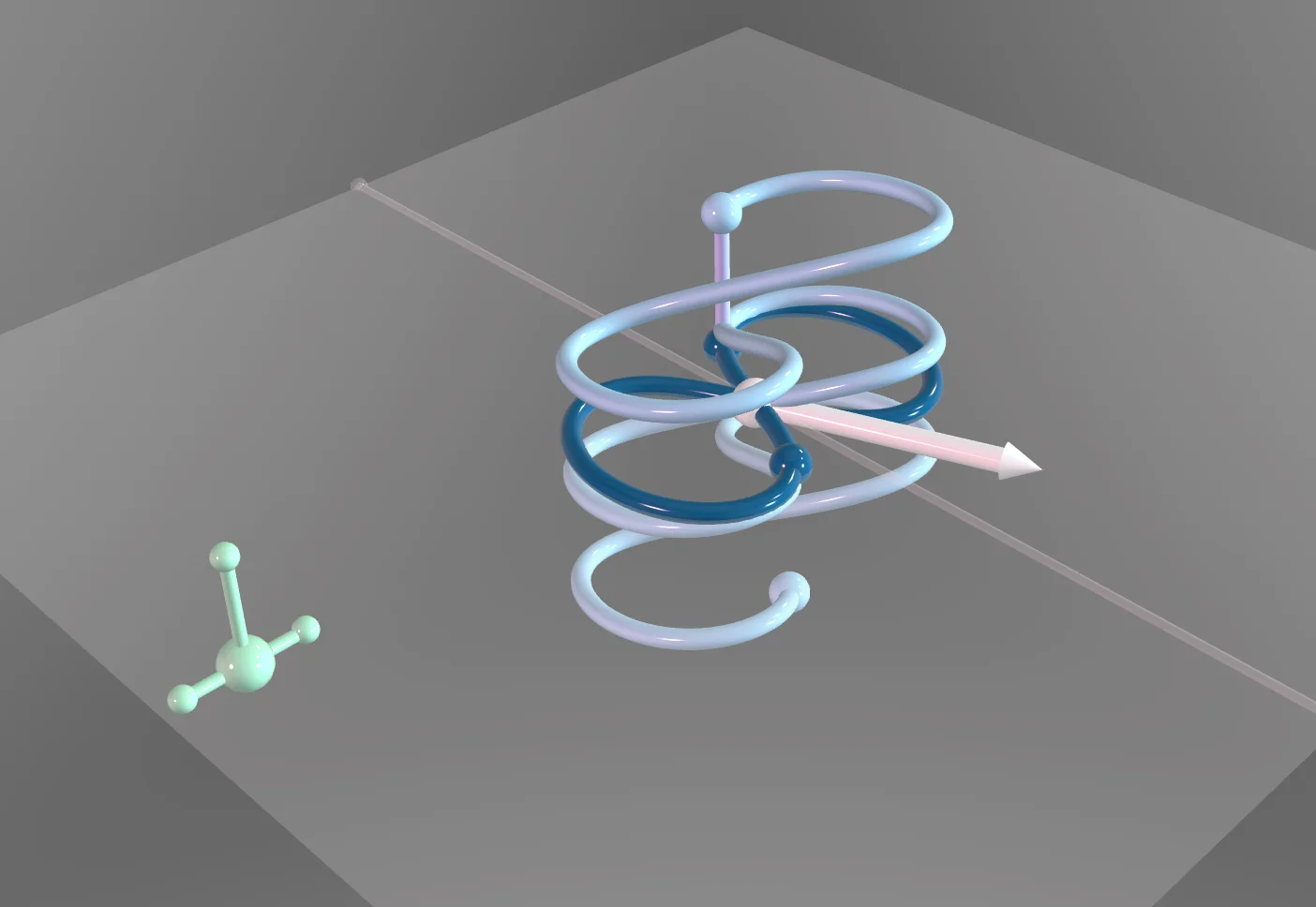
Low-Reynolds-number swimmer locomoting through cyclic shape changes, illustrating the scallop theorem
This program simulates a microorganism-like swimmer moving through a viscous fluid at low Reynolds number, where inertia is negligible and locomotion requires non-reciprocal shape changes (the scallop theorem). The swimmer consists of linked segments that undergo cyclic deformations, and the resulting net displacement is computed from the geometry of the shape space. This illustrates the deep connection between differential geometry (the curvature of the shape space) and biological locomotion at the microscale.
Controls: Click and drag to orbit, scroll to zoom.