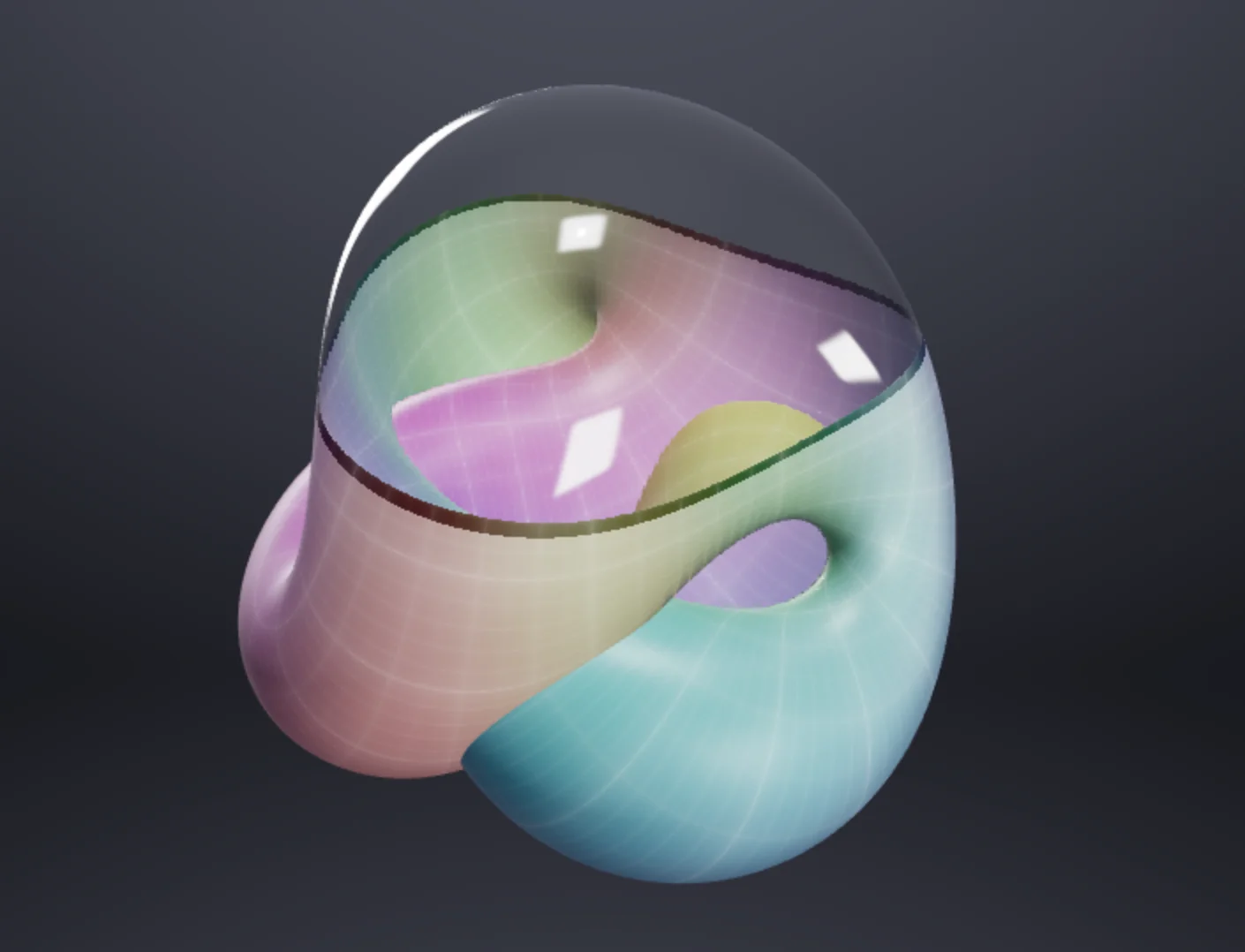
Boy's surface: an immersion of the real projective plane in $\mathbb{R}^3$ without singular points
Boy’s surface is a non-orientable surface obtained by immersing the real projective plane RP2 into R3 without any singular points (though it necessarily has self-intersections). It was discovered by Werner Boy in 1901 as a counterexample to David Hilbert’s conjecture that no such immersion existed. The surface has a three-fold symmetry and can be parametrized using spherical harmonics.
Controls: Click and drag to orbit, scroll to zoom.