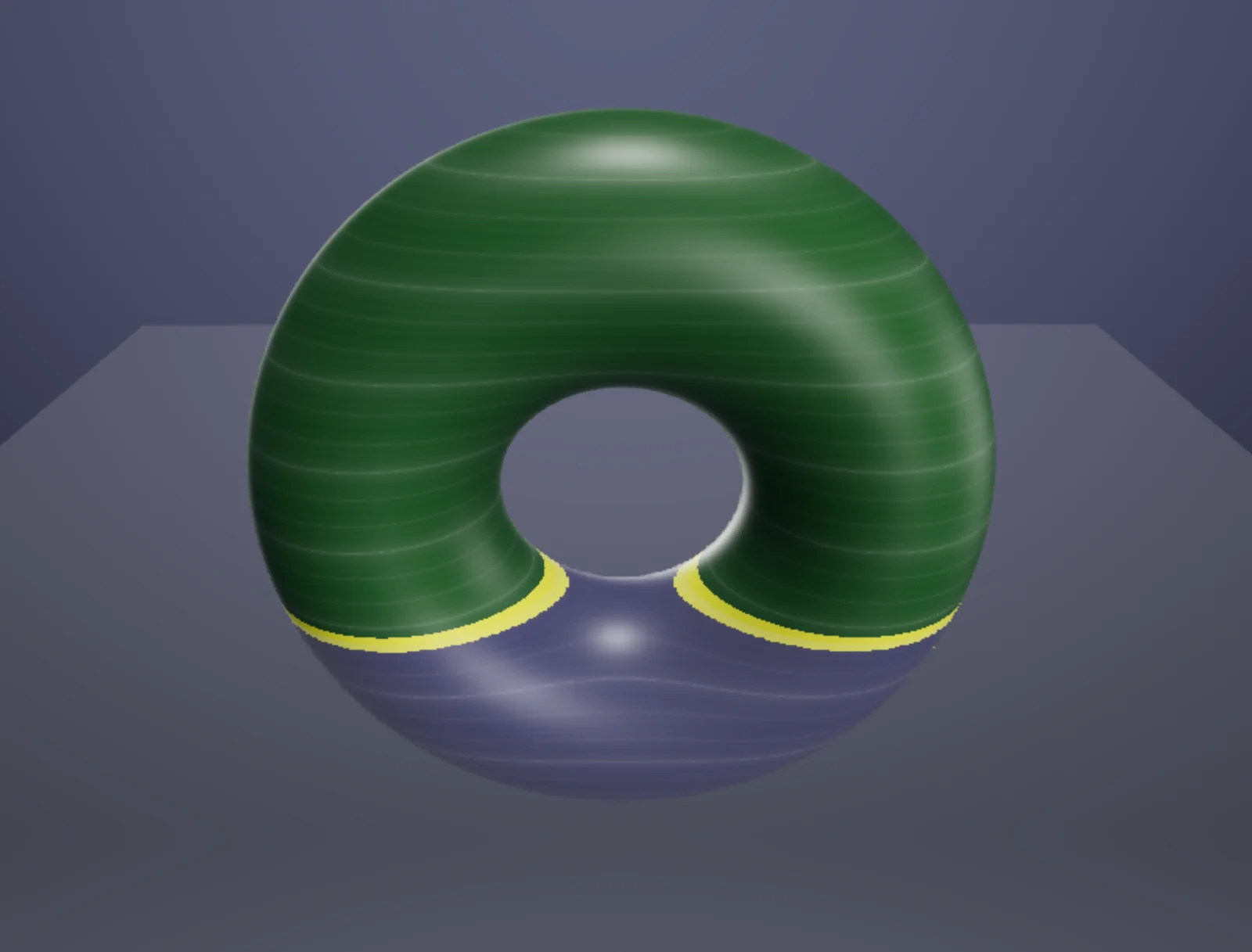
Morse function on a surface: sublevel set topology changing at each critical point
A Morse function is a smooth real-valued function whose critical points are all non-degenerate, meaning the Hessian matrix at each critical point is invertible. Morse theory relates the topology of a manifold to the critical points of such functions: each critical point contributes a handle whose index equals the number of negative eigenvalues of the Hessian. This visualization shows how the topology of sublevel sets changes as the height passes through critical values.
Controls: Click and drag to orbit, scroll to zoom.