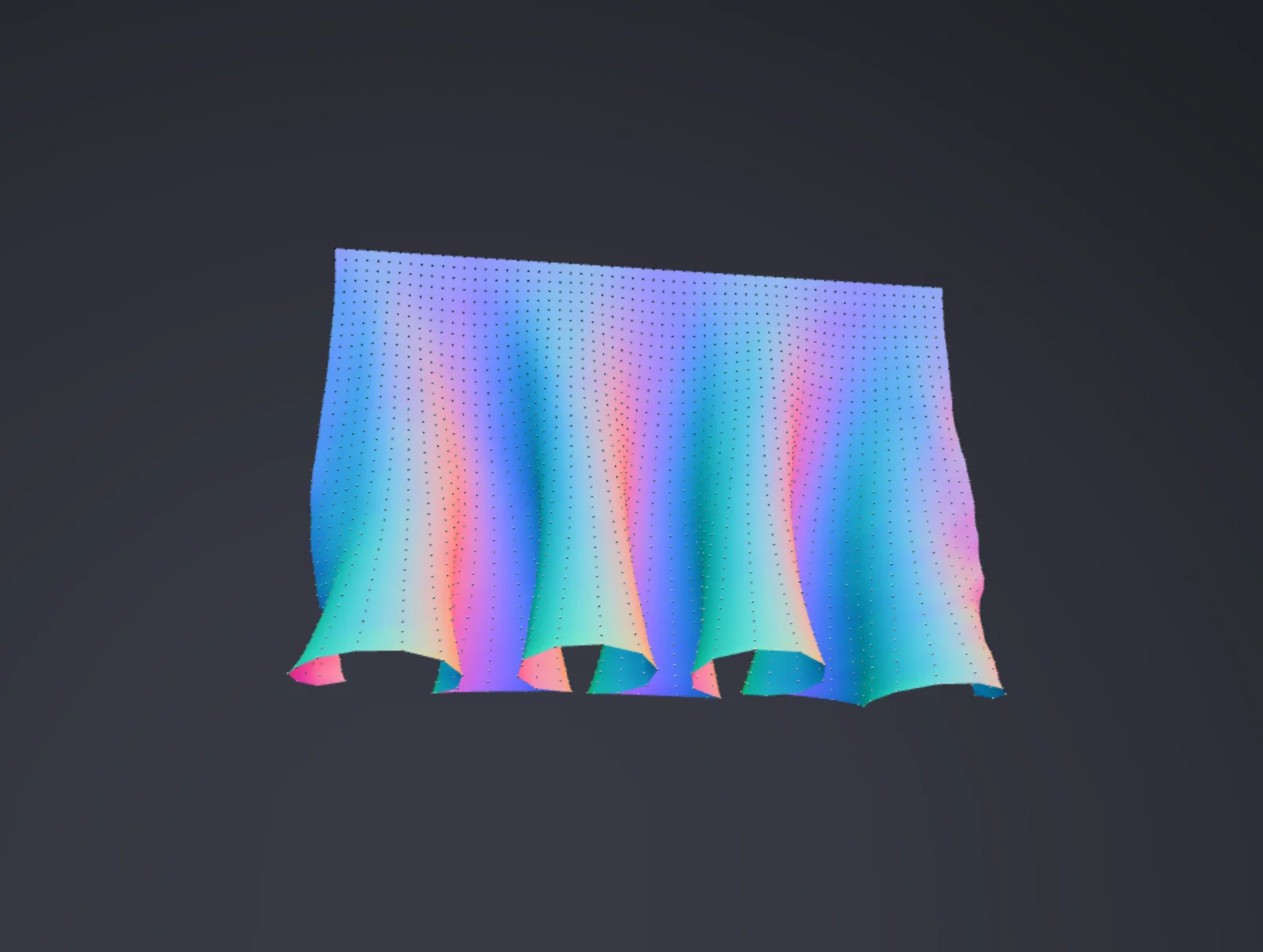
Strip of the hyperbolic plane draped as a curtain, buckling from its negative curvature
A strip of the hyperbolic plane H2 is discretized as a mesh and embedded into R3 using a spring-and-charge system. The springs encode the intrinsic hyperbolic metric via rest lengths derived from ds2=dx2+cosh2(x)dy2, while gravity pulls the mesh downward, producing a curtain-like draping effect. The system evolves via a damped Newtonian dynamics simulation until it reaches equilibrium.
The resulting shape illustrates how the exponential growth of area in hyperbolic geometry forces the surface to buckle and fold when constrained to Euclidean 3-space. Shear and bending springs stabilize the mesh, and electric charges between vertices prevent self-intersection.
Controls: Click and drag to orbit, scroll to zoom.