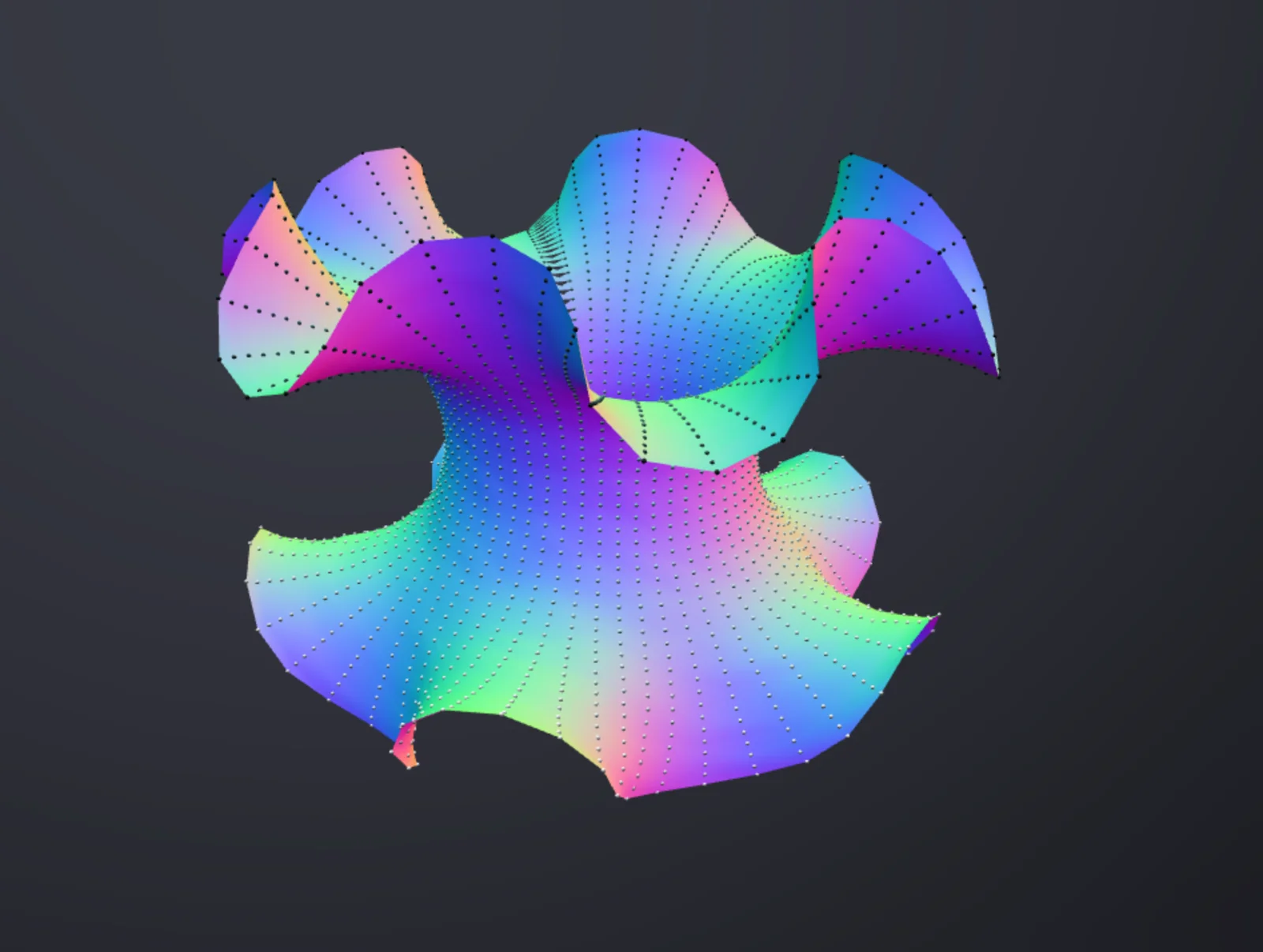
Hyperbolic cylinder embedded in Euclidean space, ruffling at its negatively curved edges
A cylindrical region of the hyperbolic plane is given intrinsic geometry with metric ds2=dx2+cosh2(x)dy2 and periodic boundary conditions in the y-direction, forming a hyperbolic cylinder. The surface is embedded into R3 via a spring-and-charge system where spring rest lengths encode the hyperbolic distances and electric charges prevent the mesh from self-intersecting.
The simulation runs a damped Newtonian dynamics integrator, with additional shear and bending springs for stability. The resulting surface shows the characteristic ruffling that occurs when negatively curved geometry is forced into flat ambient space.
Controls: Click and drag to orbit, scroll to zoom.