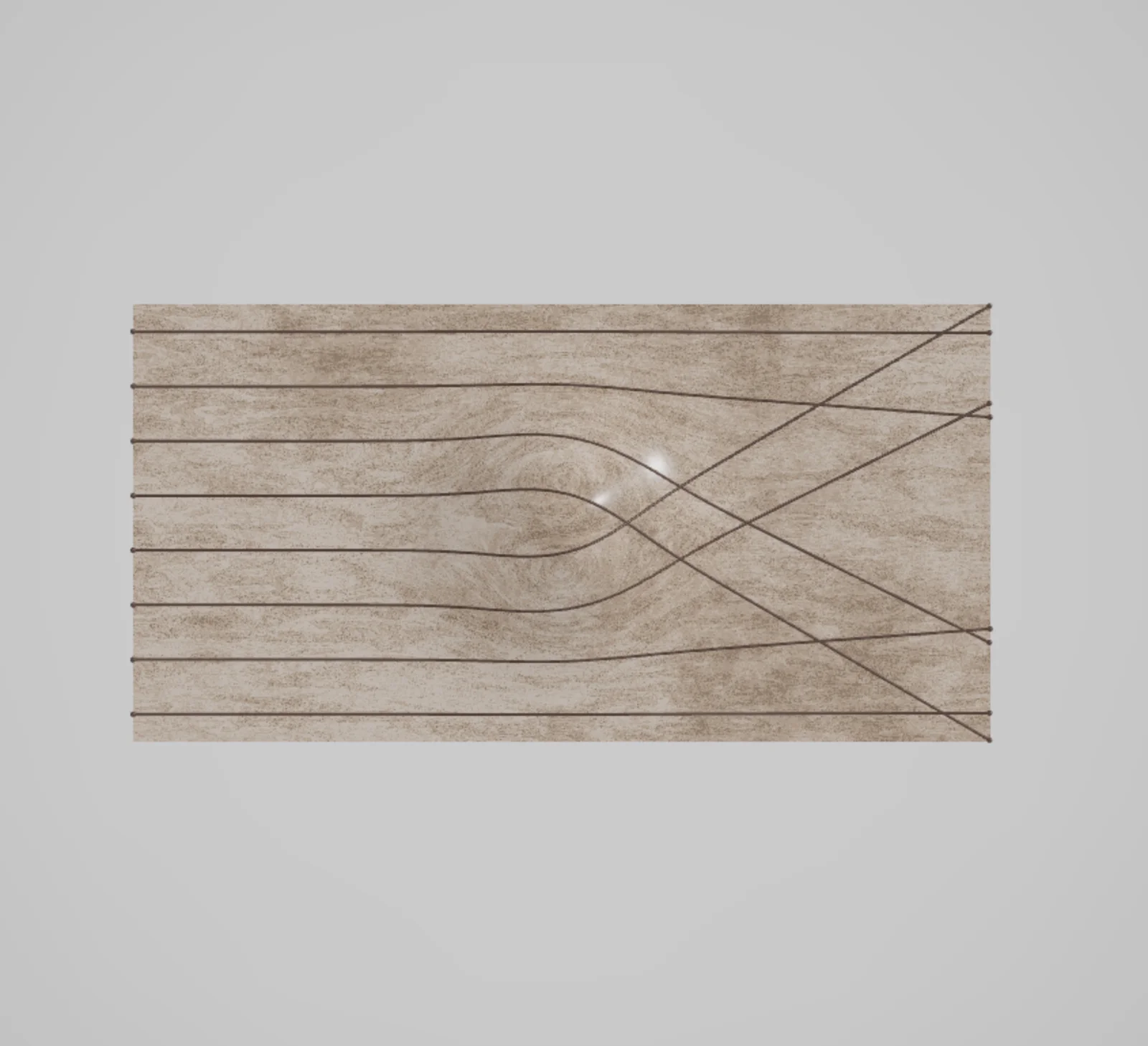
Geodesics focused by a single Gaussian bump, illustrating the effect of positive curvature
A family of initially parallel geodesics is computed on a surface with a single Gaussian bump, where the height function creates a region of positive Gaussian curvature. The geodesics are parallel-transported along the surface and rendered as metallic tubes on a wooden board.
In the positively curved region near the bump, geodesics converge toward each other, demonstrating focusing by positive curvature. This is the surface-geometry analog of gravitational lensing: curvature bends the paths of straight lines. The effect is governed by the Jacobi equation, with the Gaussian curvature K>0 of the bump acting as a focusing lens.
Controls: Click and drag to orbit, scroll to zoom.