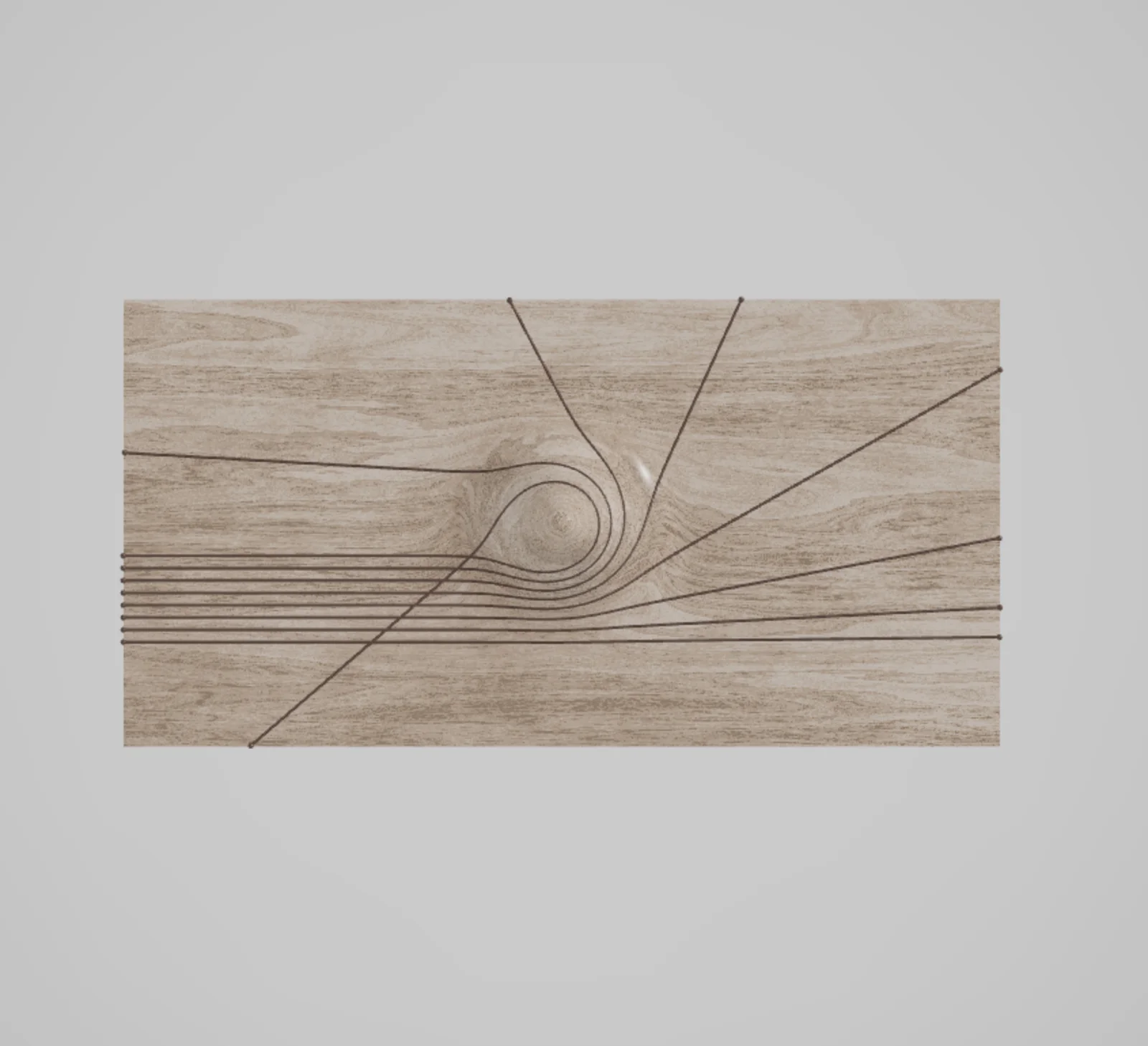
Geodesics strongly focused by a tall Gaussian bump, crossing sooner from higher curvature
A family of initially parallel geodesics is computed on a surface with a tall Gaussian bump, producing a region of strong positive Gaussian curvature. The increased height amplifies the curvature and causes more dramatic convergence and crossing of the geodesic family.
The stronger curvature means the Jacobi field J along each geodesic oscillates more rapidly, so conjugate points (where J=0) appear sooner and geodesics cross after shorter distances. The geodesics are rendered as metallic tubes on a wooden board with a procedural wood-grain shader.
Controls: Click and drag to orbit, scroll to zoom.