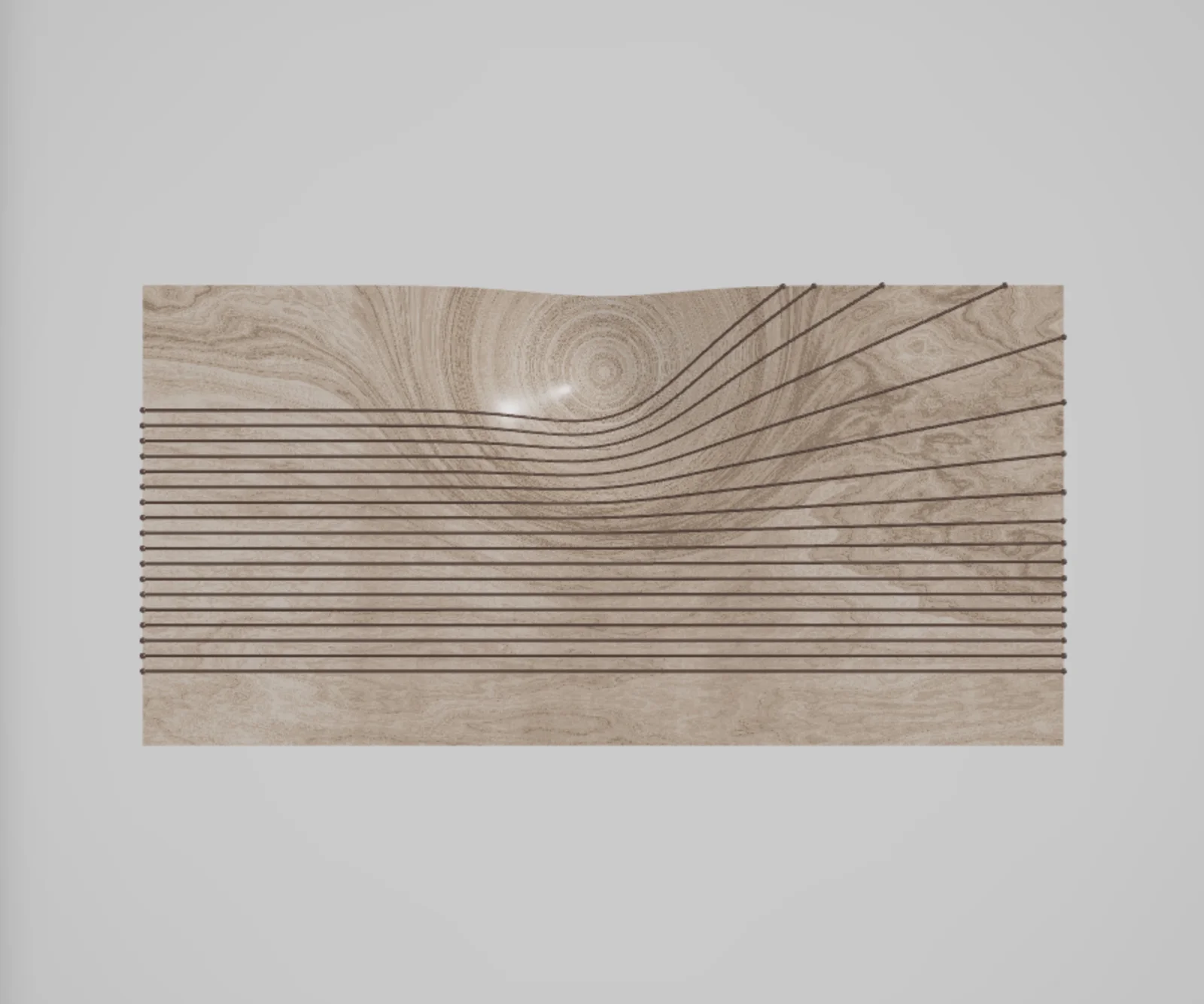
A family of initially parallel geodesics is computed on a surface with a Gaussian bump positioned off to one side. Because the bump is not centered on the geodesic family, the curvature affects different geodesics asymmetrically, producing an uneven pattern of convergence and divergence.
This asymmetric setup highlights how the location of curvature relative to a geodesic congruence determines the resulting deviation pattern. Geodesics passing closer to the bump are focused more strongly, while those farther away remain nearly straight. The board is rendered with a procedural wood-grain material.
Controls: Click and drag to orbit, scroll to zoom.