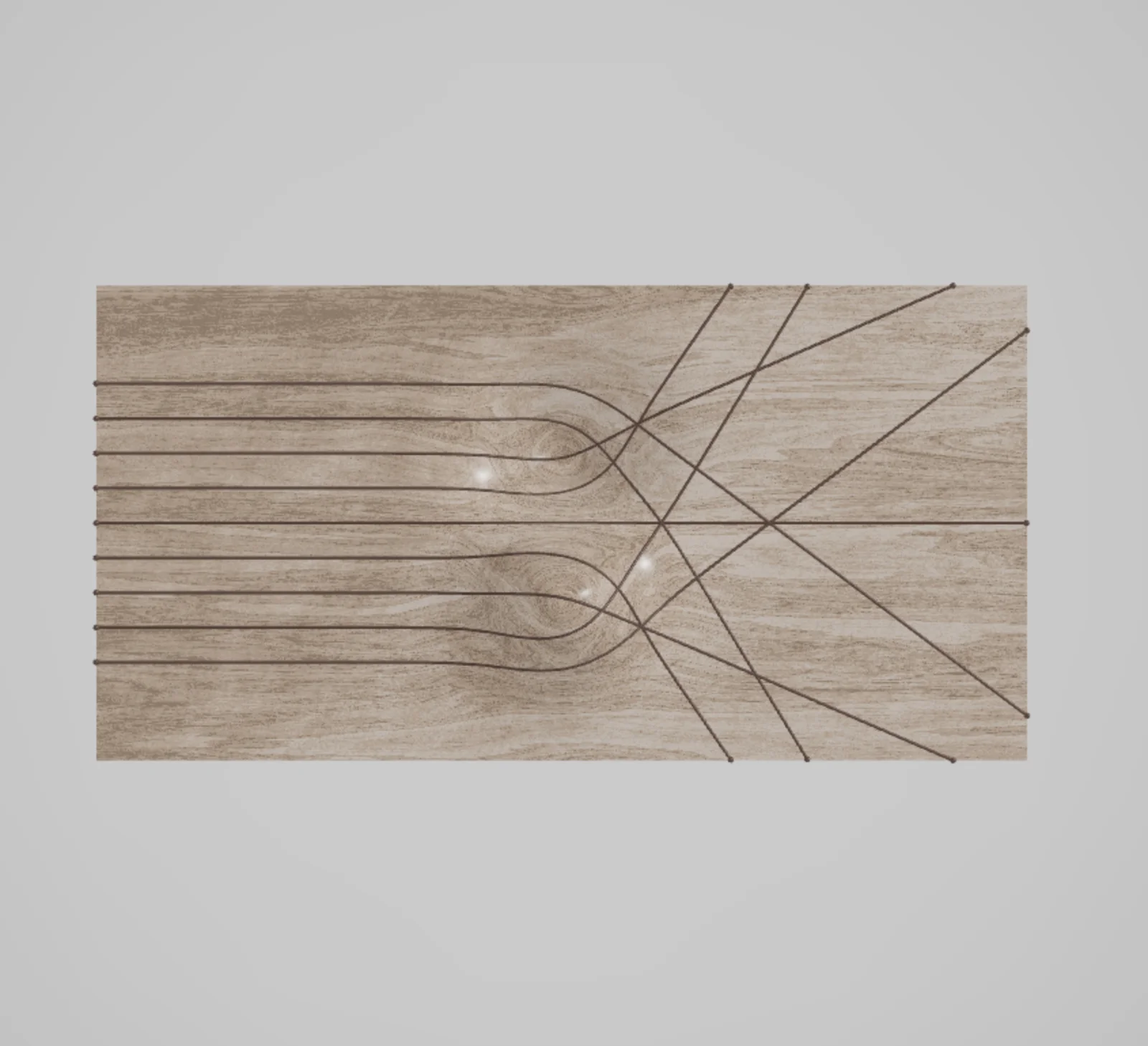
A family of initially parallel geodesics is computed on a surface with two Gaussian bumps, creating two distinct regions of positive Gaussian curvature. Each bump acts as a focusing lens, bending nearby geodesics toward its center, and the combined effect produces a complex pattern of convergence and divergence.
The interaction between the two bumps creates a richer geometry than a single bump: geodesics may be focused by one bump, then refocused or scattered by the second. The surface is rendered as a wooden board with procedural wood grain and metallic geodesic tubes.
Controls: Click and drag to orbit, scroll to zoom.