Complex Exponentials: Growth, Rotation, and Spirals
What happens when you raise e to an imaginary power.
Without question the mainstay of electrical engineering, with an “imaginary” exponent pops up everywhere: quantum theory, circuits, and even theoretical mathematics. The notion of to a complex power should raise some flags upon first encountering it; much like before we extended the exponential from the integers to the reals, the expression doesn’t mean anything until we assign it a definition and interpretation. Our goal here is to try and understand what could mean, and how to calculuate it, following our discussion of real exponentials.
Before delving into this, a quick description of the imaginary unit, i, is required. It is usually defined to be , and thought of as “imaginary” because this value does not exist on the standard number line. Here I am going to advocate a different interpretation of i, and of complex numbers in general, which will hopefully make them not seem so “imaginary” after all. The set of all complex numbers is often called the complex plane, and for a very good reason: a complex number can be written in the form for two real numbers a, and b. We can identify this complex number with the point (a,b) on the plane, which lets us think of the standard x axis as the “real” axis, and the y axis as the “imaginary” axis. Just like the points in the plane, we can think of complex numbers as being a part of a vector space (meaning we can add them), but the complex plane has an additional structure of multiplication as well. Multiplication by a real number just corresponds to a “stretch” of the complex number, but multiplication by i actually represents a 90o rotation. Lets look at a few examples:
: If we view 1 as the vector of unit length on the horizontal axis, then multiplying it by i is the same as rotating it 90o, which would line it up with the unit vector on the y-axis, the imaginary unit i.
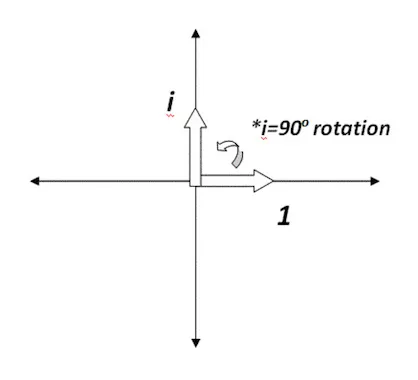
: This is the equation which has given i its interpretation as the square root of -1. A more useful interpretation of this is however that starting with 1, rotating by 90 degrees places it vertically on the y-axis, and another 90 degree rotation forces it to lie back on the x-axis, but pointing to the left. This more geometric interpretation is shown below
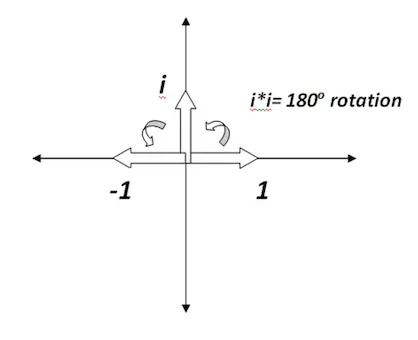
From this view of i, we can construct a meaningful interpretation for the expression : It represents n successive 90 degree rotations, or a total rotation of radians. The cyclic nature of this function, cycling through the values {1,i, -1, -i} is shown below.
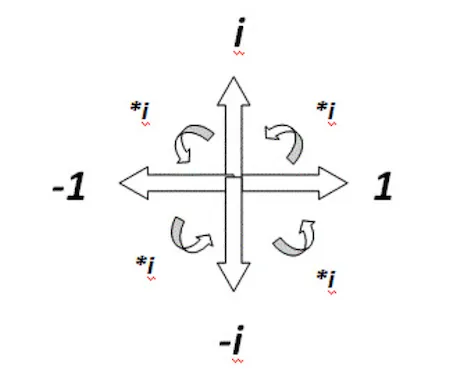
We now have enough background to discuss what it means to raise something to an imaginary power. Looking at our previous interpretation of the exponential, ei would represent the result of growing at rate i for one time unit. The fact that this does not make much sense at all is ok, we have simply moved our problem from figuring out what ei means to what it means to grow continuously at rate i. Since i is simply a rotation, we may guess that “growing at rate i” may really mean “rotating,” but to put any faith in this guess we will need some sort of proof. For this, we will go back to our definition of er as the limit of dividing a growth rate of r over the unit interval
But this time, we will let the growth “rate” be a 90 degree rotation: i. For now, we will set this as our definition of what ei means, and see if it has any useful properties.
Like before, we will try to gain some intuition by looking at the finite cases, on the way to the limit. For, say n=5, this can be written
Where we can think of each of the quantities in parentheses as a set of “directions” for what to do to the vector 1. After the set, we have the new vector , which can be interpreted as leaving the vector 1 alone, and adding to it a copy of itself rotated by 90 degrees and shrunk by a factor of 5.
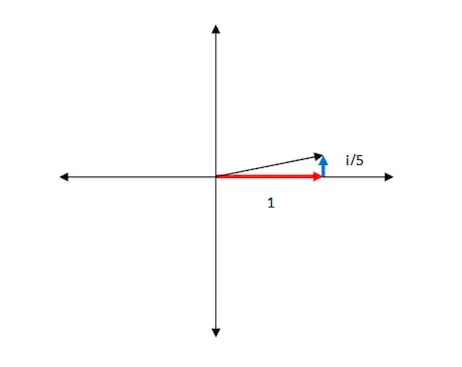
Multiplying the second set of parentheses then takes this new vector as input, and adds to it a copy of itself rotated by 90 degrees and shrunk to 1/5th its normal length
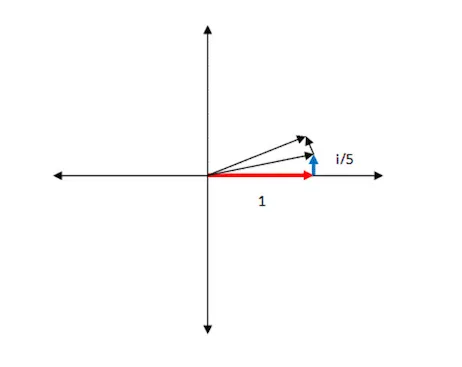
Performing the next three sets of directions, we see the following picture emerge:
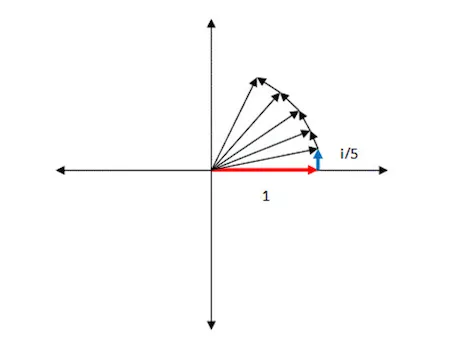
Thus it appears there is something to our original guess that an imaginary exponent encodes rotation of some sort or another. In the above diagram, we see that the vector grows slightly in length with each rotation. However as we take larger and larger terms in the limit, the length increase is made smaller and smaller. In fact, in the limit, we start with the vector 1, and perform an infinitesimal rotation of it in the positive direction (by adding an “infinitely small” copy of itself rotated by 90 degrees), and then we repeat this over and over and over, slowly rotating the original vector more and more in the positive direction. What final value does our limit,
converge to? We can calculate it numerically and see that it reaches the point (0.540302, 0.841471). The limiting path traced by the point on its way to its final destination is shown below.
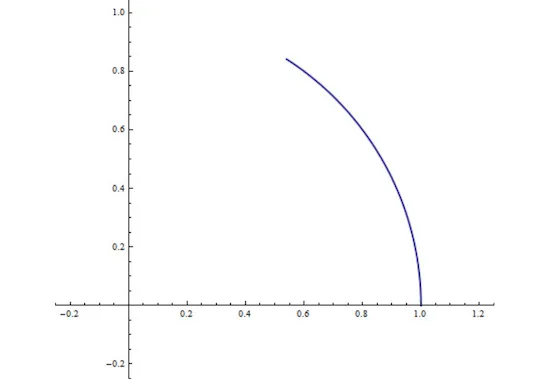
While the specific coordinates of the point did not help us much understand what is going on, this picture is worth a thousand words. It turns out that the arc length above is exactly 1. That is, after unit time has moved exactly unit length along the circle. Thus, we were correct in guessing that imaginary exponents represented rotation, and even in this regime we find that e is a very special base: e is the base which represents rotation of unit speed when raised to an imaginary exponent. That is, not only is e the representation of 100% growth, but also of 100% rotation. What if we continue for t time units along this rotation path, instead of just 1? Since the point is traveling at unit speed, after t units it would have traversed a distance of t along the unit circle; or as we would usually say, the point would have been rotated by t radians. This allows us to assign a very intuitive picture to the commonly used expression : it means to travel distance along the unit circle, starting from 1 - that is, it represents a rotation of radians.
If the base e represents rotation at unit speed, then what happens when we raise a different real number to an imaginary power? Just like in the previous cases, we are able to rewrite this new exponential in terms of e using the inverse function ln:
After a unit time, this reaches the point , which from our above interpretation is just a rotation of ln(a) radians. Thus, the speed of rotation must be ln(a). Just as different bases represent horizontal stretches in the real numbers, they represent different rotational speeds in the imaginaries.
We only have one more thing to discuss before we can fully interpret the imaginary exponential: what function the multiplicative constant out front has. Just like in the real case, we are able to write every imaginary exponential in the form for stretches in the independent and dependent coordinates. We have already come up with a satisfactory interpretation for the constant preceding t: it is the rotational velocity (angular frequency) of the prescribed rotation, given in radians/time unit. What does the factor r do? Lets look at the case of t=0. Before r was introduced, the starting point of this function was the vector 1 in the complex plane. However, our new function has starting point r. Rotating this initial vector then at speed just traces out a circle of radius r, instead of the unit circle. The constant out front simply changes the radius of the circle on which the rotation is performed! This gives us a nice pictorial representation:
Complex Exponentials
We now have nice pictorial representations for exponentials with real or imaginary exponents. The most natural extension is to combine these; what happens if we have a complex exponent (one with both real and imaginary parts)? Because we can always write things in base e if we’d like to (and all of our interpretations are nicest in that base), we will write a general complex exponential as
Before going through with this, we will look a bit at what is in the exponential to start with. In our original case of real exponents, the argument of the exponential was the real line (the input was of the form bt)
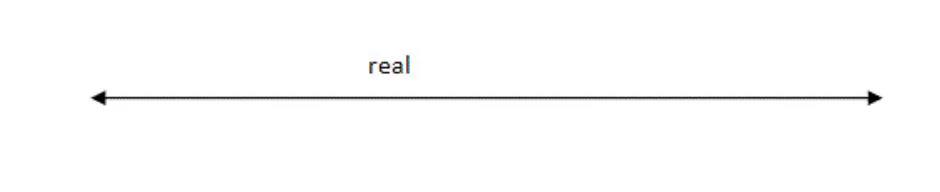
After that, we extended it to exponents of the form ibt, making the argument of the exponential be the imaginary axis of the complex plane
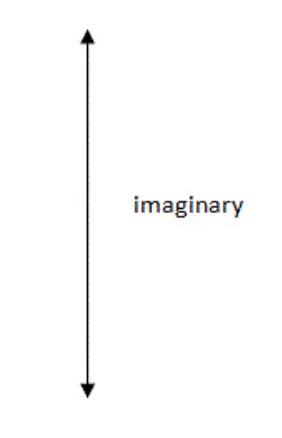
Now, we are attempting to use as an argument the term (a+bi)t, which is a general line in the complex plane through the origin with slope b/a:
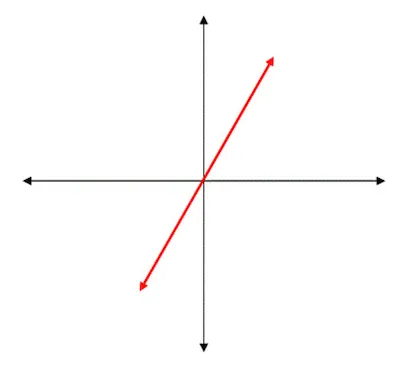
If the real axis results in growth and the imaginary axis in rotation, what could exponentiating a line in between the two result in? If you guessed rotation and growth, you’re on the right track! Lets try and put some rigor to this: looking at our above symbolic expression, we notice that we can use the laws of exponents to break the addition in the exponent into the product of two exponentials:
We have already assigned an interpretation to each of these terms, so understanding complex exponents is actually no problem at all: the r simply represents the length of our vector at t=0; the starting radius. The term represents continuous growth at rate a, but here it is multiplied by the term which represents a rotation at angular speed b. Putting it all together, we have an initial radius of r which changes continuously at rate a, while simultaneously rotating at speed b. To keep the spirit of the previous sections, we will write this out mathematically:
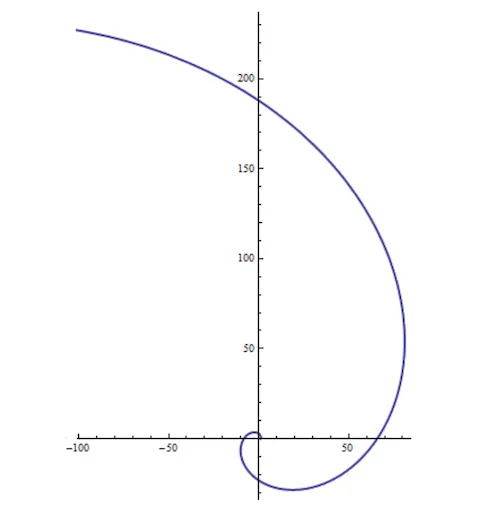
Below is an animation of this process: it shows both the line in the complex plane which is taken as input, and the output of the exponential map. Note how when the line tends to the vertical (imaginary axis), the spiral limits in on the circle.


And heres the picture for initial radius=1, rate of growth=2, and rotation rate=3 (that is, the exponential map of the line with slope 3/2 through the origin of the complex plane)
Euler’s Formula
After all of the work we have done, the following may actually appear a rather trivial observation. However its usefulness cannot be overstated: Euler’s formula is a connection of exponentials to trigonometry; in a way so simple and so elegant that one can translate between the two representations with ease. To see this connection, we will head back to the (hopefully now rather simple looking) eit. This just represents rotation at unit speed about the unit circle, and looks something like this

At the value our point has moved radians. The expression eit stands for this final position in the plane, but lets say instead of such a holistic view we would like an actual coordinate representation. That is, we would like to be able to write eit=(a,b) for some a, b. Because the point (a,b) lies in the complex plane, we can also represent this point by the expression a+bi if we would like, but this is just a notational option, theres no real new information here. Lets look at what our coordinates would be. We know that the point eit lies t radians away from the x axis, and that it lies on the unit circle. We can then use simple trigonometry to get the x and y projections
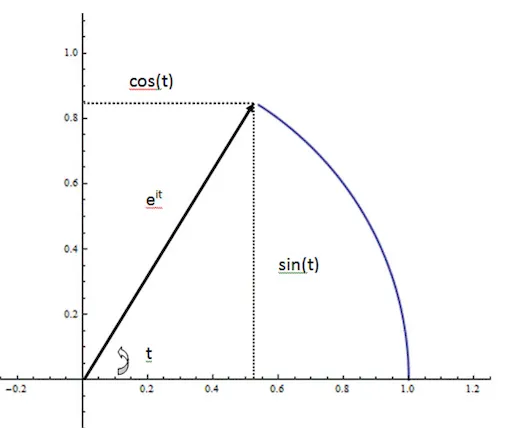
This leaves us with the coordinate representation Which we can re-write as a point in the complex plane as follows:
Which is Euler’s celebrated formula. This is simply an expression that continuous rotation at a unit speed (our definition of the symbol eit) has a coordinate representation in terms of the trigonometric functions of the unit circle; which is nothing new. However take a step back, and forget all the interpretations and the work we have done so far; what this equation says is nothing short of amazing: the exponential function and the trigonometric functions were discovered independently, and their graphs look nothing alike. However it turns out that they are really one in the same. There is an over-reaching function on the complex plane such that when we restrict it to the real axis, we get growth, when we restrict it to the imaginary axis, we get oscillation, and all combinations of the two lie in-between. Rotation and exponential growth are two inseparable ideas, two faces of one function. Like space and time were fused by relativity theory into an immutable whole, growth and oscillation were by complex analysis.
The most well known use of Euler’s formula is to show the rather startling identity
This is simply a re-arrangement of the equation , which says that a rotation of radians simply moves 1 to -1.