Properties of the Fourier Transform
How symmetry and translation affect the frequency spectrum.
From our discussion in The Fourier Transform, we have come to terms with what it means to write a function in terms of its frequency spectrum. From here, we can go on to look at not only the frequency spectrum of a function, but also how that spectrum changes when we alter our original signal in one way or another. That will be the main topic of this post: how do alterations of a function affect its frequency spectrum, and how do manipulating the component frequencies in turn alter the function itself?
Even and Odd Functions
First off, just in case this terminology isn’t familiar, an even function is one thats “symmetric” when you reflect it about the y-axis; that is its right half looks exactly like its left.
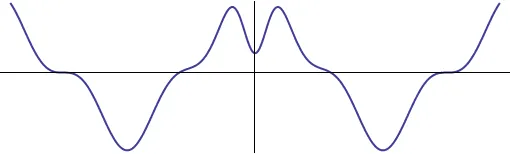
On the other hand, an odd function is one that is “antisymmetric” when reflected about the vertical, its right half is an “upside-down” copy of its left half.
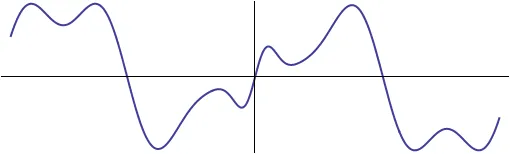
These two notions can be made precise in symbols by saying that the value of an even function at points equal distance from the origin is equal; or
Whereas for odd functions the values at points equal distance from the origin are opposites of eachother:
It will be beneficial for us to keep the following geometric consequences of even-ness and odd-ness in mind
- Reflecting an even function about the y-axis does nothing
- Reflecting an odd function about the y-axis has the same effect as reflecting it about the x-axis
So, armed with only this, is there anything we can say about the kind of frequencies which contribute to even (resp. odd) functions? The Fourier Transform of a function gives us information about its component frequencies; namely both their magnitude and their phase. The phase information encoded is the initial phase, or the phase of the sinusoid at the origin. This phase of course is just a relative phase; meaning its the phase difference of the contribution from our chosen standard exponential .

Here’s an example of what I mean: to the below is our basic model for a sinusoid, which we take to have zero initial phase.
And now is our model including an initial phase term.

What does this have to do with even and odd functions? Well, looking at the oscillatory models above, we can see that the x-projection of our “zero-initial phase” rotating vector is simply the cosine curve. And so, every oscillation that contributes with zero initial phase contributes cosinusoidally to our sum. What happened if every contributing frequency contributed with no initial phase? Well, then writing our function f in terms of its frequency decomposition, we would see that it is made wholly out of cosines. It should be easy to convince yourself that if you have two even functions and you add them, the result will be even (think about each function individually; since they are even, reflecting them about the y-axis does nothing. After you have added them, what happens when you reflect the sum about the y-axis?). Importantly; this property carries over even to continuous sums. Adding a continuous spectrum of even functions will also leave you with an even function at the end of the day.
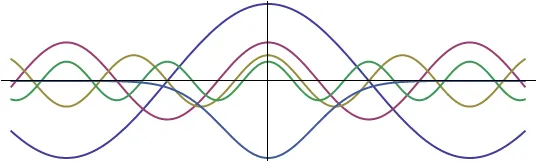
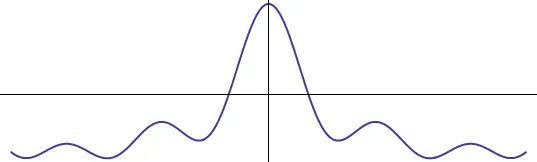
Thus, we know that if each Fourier component contributes zero initial phase; then the resulting summation is an even function. But this resulting summation is just f itself! (Remember; the “inverse Fourier Transform” is really just a way of writing f as a sum of its projections onto different oscillations). Putting it all together, we have seen that so long as the frequency spectrum of f has no initial phase for any frequency, f is an even function.
Remember from The Fourier Transform, we noted that the frequency spectrum was in general complex, and could be written in the form
Where is the amplitude at frequency and is the initial offset of the phase. If all frequencies contribute with zero initial phase however, that means we can write the frequency spectrum as
And thus, the frequency spectrum is a real-valued function! Combining all of these small steps, we can make a significant claim about the nature of the Fourier Transform of an even function:
The Fourier Transform of an even function is real
What about odd functions? Well, let’s see if we can’t just re-apply the reasoning from above. Sums of odd functions are also odd functions (convince yourself of this using the geometric observation about odd functions above), and so we know that if f is an odd function, then if we break it down into component frequencies, each contributing frequency will be odd (a sine wave).
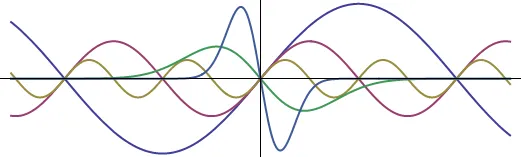
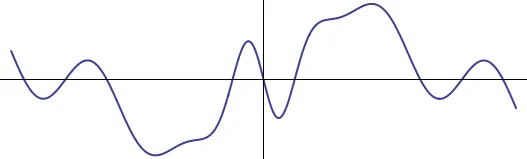
What is the initial phase of a sine wave using our model of basic oscillation being ? Well, a sine wave is just a quarter wavelength out of phase with a cosine, so we need a phase shift of a quarter-wave. Lets look back at our base oscillation.
Offsetting this by a quarter wave (making it start on the positive y-axis), is equivalent to rotating the whole setup by 90 degrees, or . Looking at our Fourier Transform as composed of both an amplitude and phase for each frequency once more, we see that must be a constant for all . That is, we can write the frequency spectrum of an odd function as
This can however be further simplified. The above equation says “take an amplitude A(k) (lying on the x-axis), and then rotate it 90o clockwise to get the correct value of the Fourier Transform. But, a 90o clockwise rotation just puts the value onto the y-axis (imaginary axis) instead. Thus, rotating a real function by 90o is the same as having a purely imaginary function to start with. This lets us write
And again, we have reached an important, general conclusion:
The Fourier Transform of an odd function is purely imaginary
Horizontal Translation of a Function
Let’s say we got some function f(x), and we decide to slide it to the right by a certain amount:

Symbolically, this can be accomplished via a change of variables for the x-coordinate:
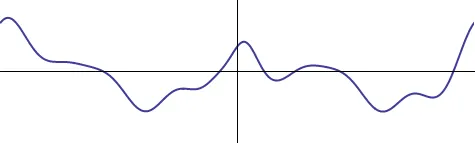
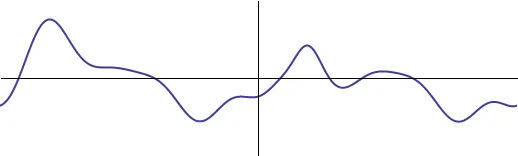
If we wanted to, we could break each of these down into their component frequencies; which begs a question: if we know the frequency spectrum of f, is there any easy way to determine the spectrum of a shifted copy of it? Turns out that there is; let’s see why.
First off, it will be most useful once more to consider the frequency spectrum to contain two different pieces of information: for each frequency it separately stores the magnitude by which it contributes, and the initial phase. First off let’s consider the magnitude of contribution: could sliding a function horizontally change that? It seems that it shouldn’t, sliding something doesn’t change its shape, and adding more (or less) of a particular frequency would definetly change the shape of a signal. That only leaves us with the phase component to worry about. However, this isn’t nearly a convincing enough argument. To see what’s actually going on, lets view f as a sum of frequencies
From this sum, we will pick out a particular frequency, call it , and reason about what happens to it when we slide . Let’s say that the contribution of this particular frequency to is
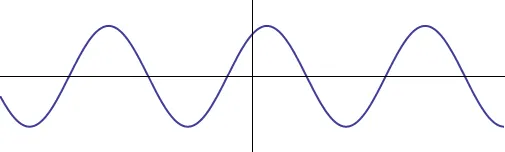
Now, we want to know what the effect of sliding is. Since is made of all the component frequencies like this one, we can slide by sliding each component in unison:

Sliding this sinusoid obviously didn’t change its amplitude, so we were correct in assuming that a horizontal translation wouldn’t change the “amount” of each oscillation in f. However, the initial phase (the phase at the origin) is now different than before. How can we quantify this difference?
We have moved the function a distance of , and the fact that the oscillation under consideration has angular frequency ko means that the change in phase over a distance of is simply .
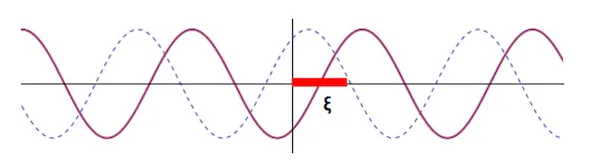
Thus, sliding this frequency component over has introduced a new phase shift at the origin, greater than before. This increase in phase shift can be modeled by multiplication by . Recapping, the magnitude of the contribution remains unvaried, and is added to the phase. In symbols
But our frequency was arbitrary, so this holds for every component of the Fourier transform. We’ve been writing for the fourier transform of , emphasizing the fact that this is a function of frequency, but forgetting what the input variable was. But here it will be convenient to instead write to emphasize that its the function which is being transformed.
Thus, we will write for the transform of the function we have slid. And, as after sliding we know the amplitude remains unchanged but the phase gets offset, we have
But recalling the laws of exponents we can break this term up and simplify: . Putting this back in, we see that the fourier transform of our shifted function has both of the terms from the original, and just one new one - this phase shift!
This is amazing! We’ve derived the shift propert of the fourier transform
Shifting a function’s input by multiplies the foruier transform by