The Pythagorean Theorem
Four triangles, two squares, one identity.
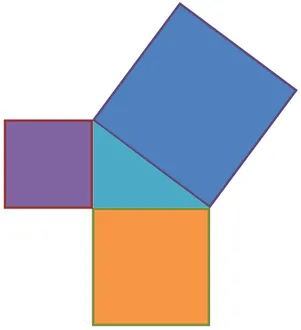
As likely the most “famous” theorem of Greek geometry (in the sense that schoolchildren the world over can rattle off the equation , often before understanding what it means!), the pythagorean theorem is the tool that lets us measure distances in the coordinate plane. As such an old and important result it has attracted many proofs and demonstrations over the years, and I’d like to present one here that I particularly liked when first shown to me.
You can even follow along with a piece of paper and some scissors if you’d like!
The Statement
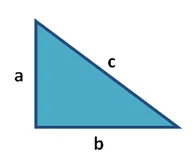
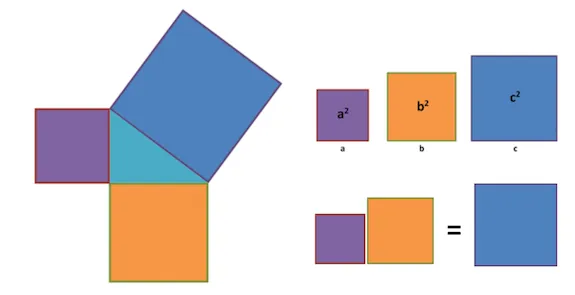
The Pythagorean Theorem states that if a right triangle has side lengths a,b,c, with c being the hypotenuse, then . An example of such a triangle with the sides labeled is to the right. Interpreting the equation we are trying to prove geometrically, it says that given a right triangle, the area of the square which sits on the longest side is equal to the sum of the areas of the squares that fit on the other two.
The Argument
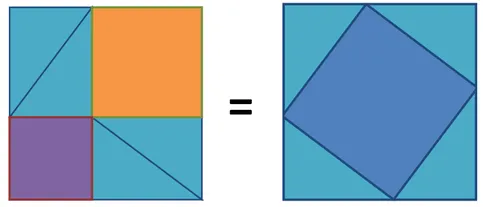
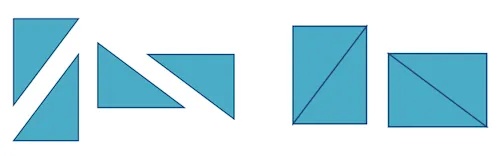
To argue that this equality of areas must hold, let’s start out by taking the original triangle and making four copies of it.. We can then take those four triangles and put them together in pairs to form two rectangles with side lengths and .
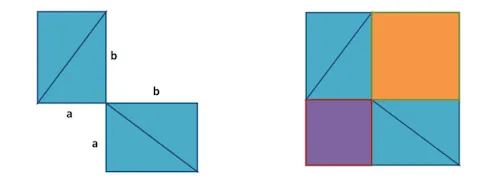
Now we can set these rectangles next to each other so that they are touching only at a point, and have next to them room for a square with side length and side length . Then fill those gaps in with squares of the right size to make one big square with side length !
Now this isn’t the only way to take four triangles like this and place them inside a square with side length : instead we could arrange them around the outside of the square, touching “tip to tip” and leaving a whole in the middle, which turns out to be a square of side length (question to think about: why is it not a rhombus?)
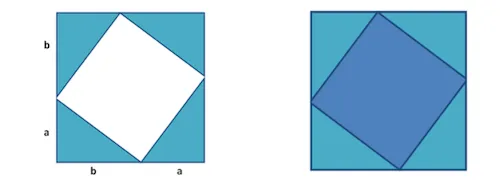
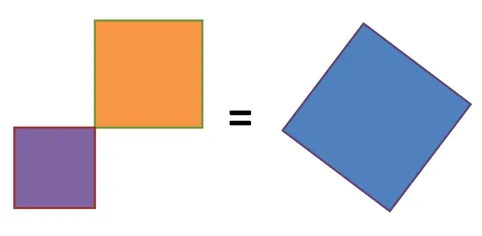
Now we’ve taken the big square and put our four triangles into it in two different configurations; but this clearly doesn’t affect the area of any of the shapes involved so the area of the “gaps” between the triangles in both pictures must be equal as well: