Alternating side lengths as natural coordinates on moduli space.
Right angled hyperbolic hexagons have proven to play a foundational role in the understanding of surfaces: two can be glued to make a pair of pants, and all orientalbe surfaces can then be built from the resulting pants.
Here’s a calculation of the
Hyperbolic Hexagon Moduli
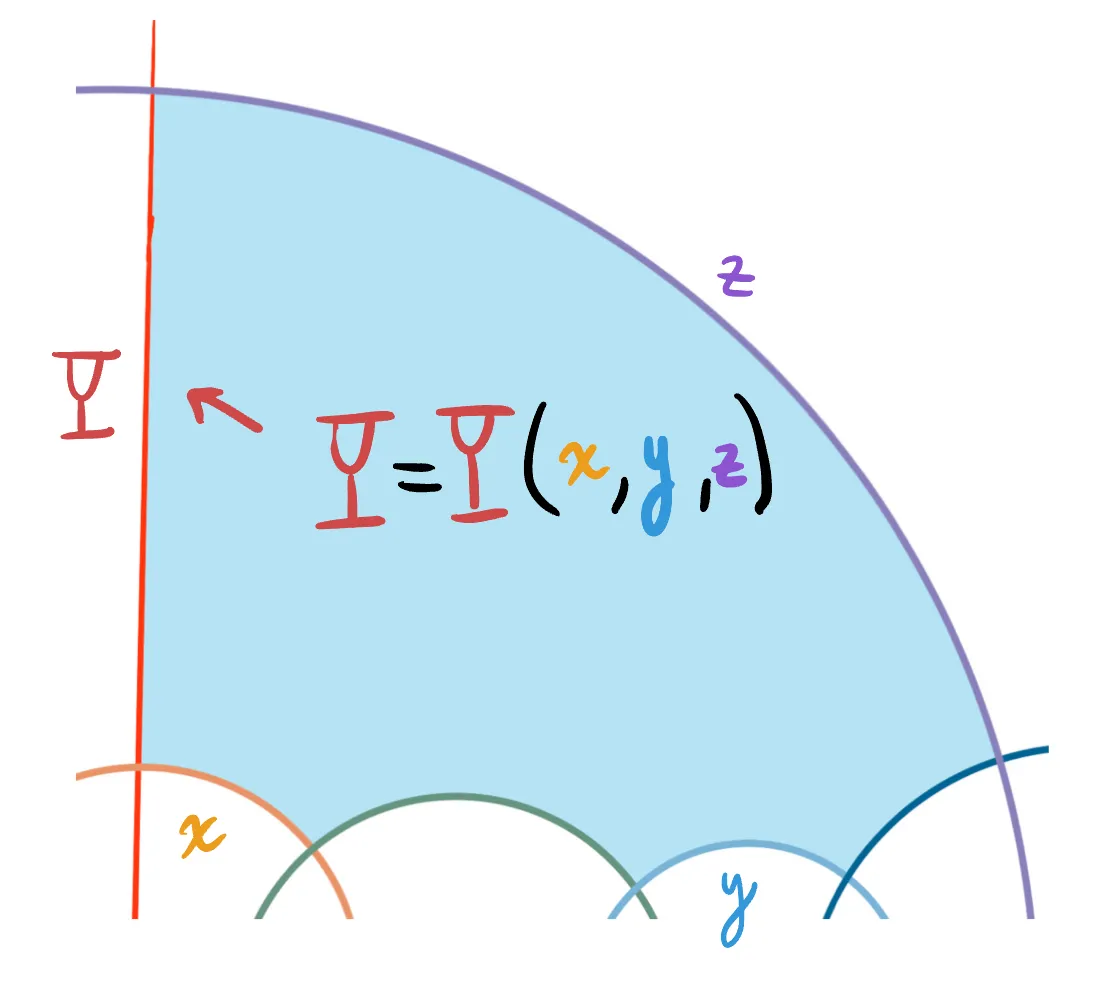
The space of right angled hyperbolic hexagons is homeomorphic to R3, parameterized by a triple of alternating side lengths x,y,z.
PICTURE
Quantitatively, the remaining three sides X,Y,Z (oppoiste x,y,z respectively) are determined by
Here’s an explicit computation in hyperbolic trigonometry, starting from three side lengths x,y,z and giving the unique lengths of the opposing three sides X,Y,Z which produce a right angled hexagon. Because the situation is symmetric in the labels we shall just compute one of them, finding Y as a function of x,y and z.
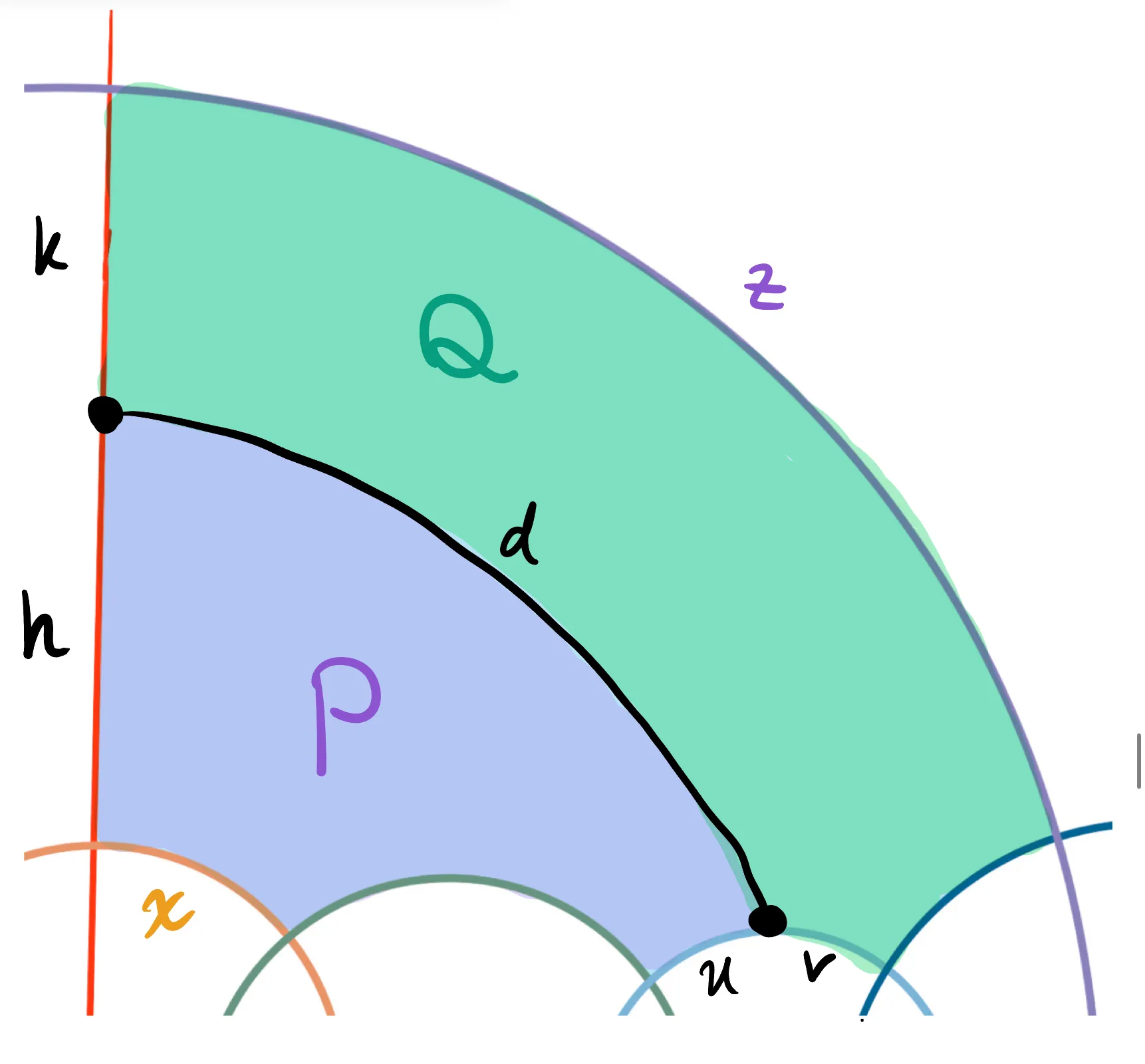
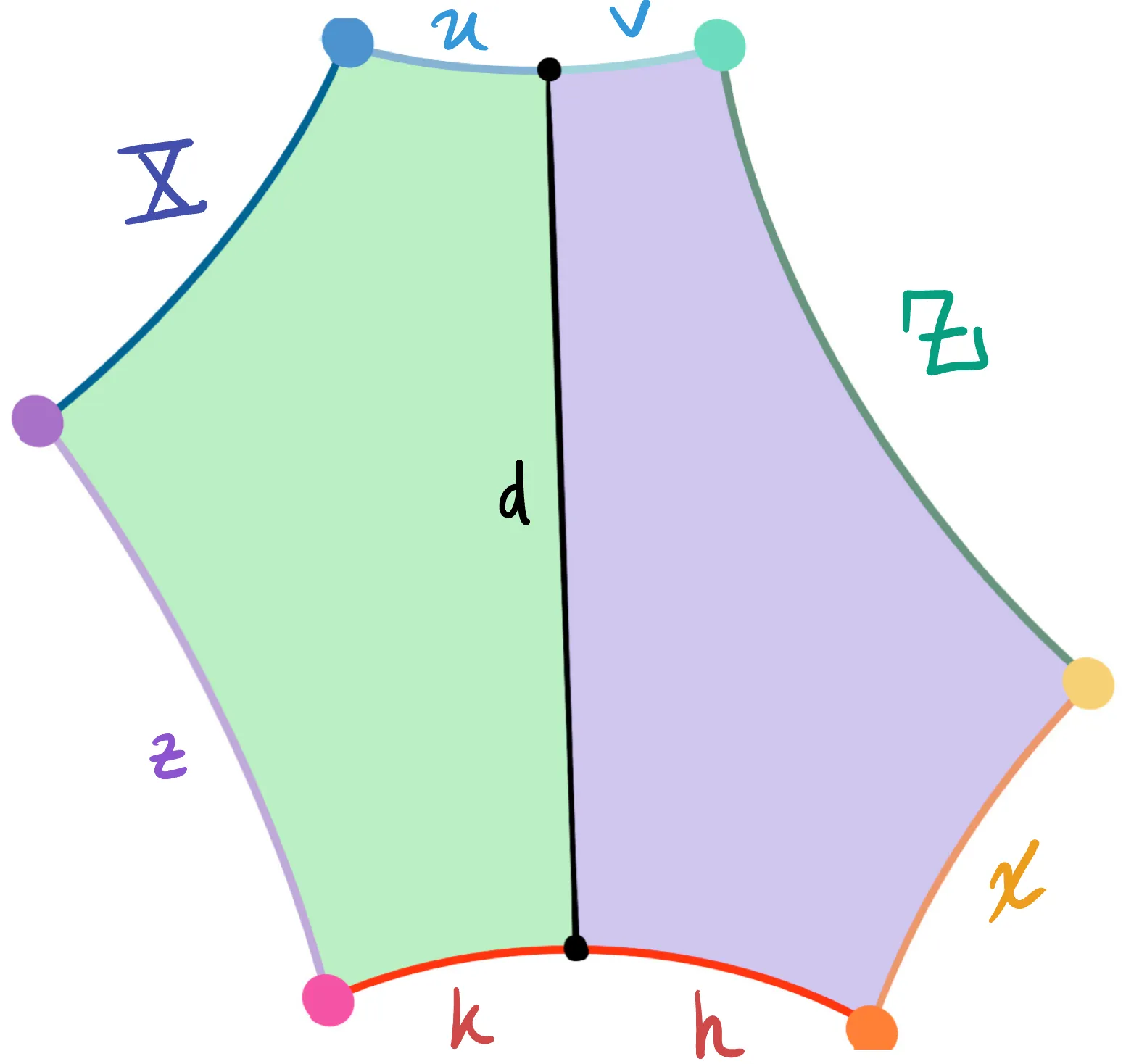
To begin, we again draw the common perpendicular to the Y,y sides, dividing the hexagon into the same pair of right angled pentagons as above. Both the edges Y and y have been subdivided, into segments of length h,k and u,v respectively, by this perpendicular of length d.
Call the resulting pentagons P and Q.
As all calculations here are independent of the model of hyperbolic space used (we are looking for hyperbolic lengths, not coordinates) we will switch below to a more abstract picture, to make drawing things easier.
The quantity we wish to calculate is Y=h+k, and we note that it suffices to calculate cosh(Y) or sinh(Y) to uniquely specify Y’s value. Recalling the angle-sum law for the hyperbolic cosine, we see that this can be expressed in terms of sinh and cosh of the lengths h,k:
cosh(Y)=cosh(h+k)=cosh(h)cosh(k)+sinh(h)sinh(k)
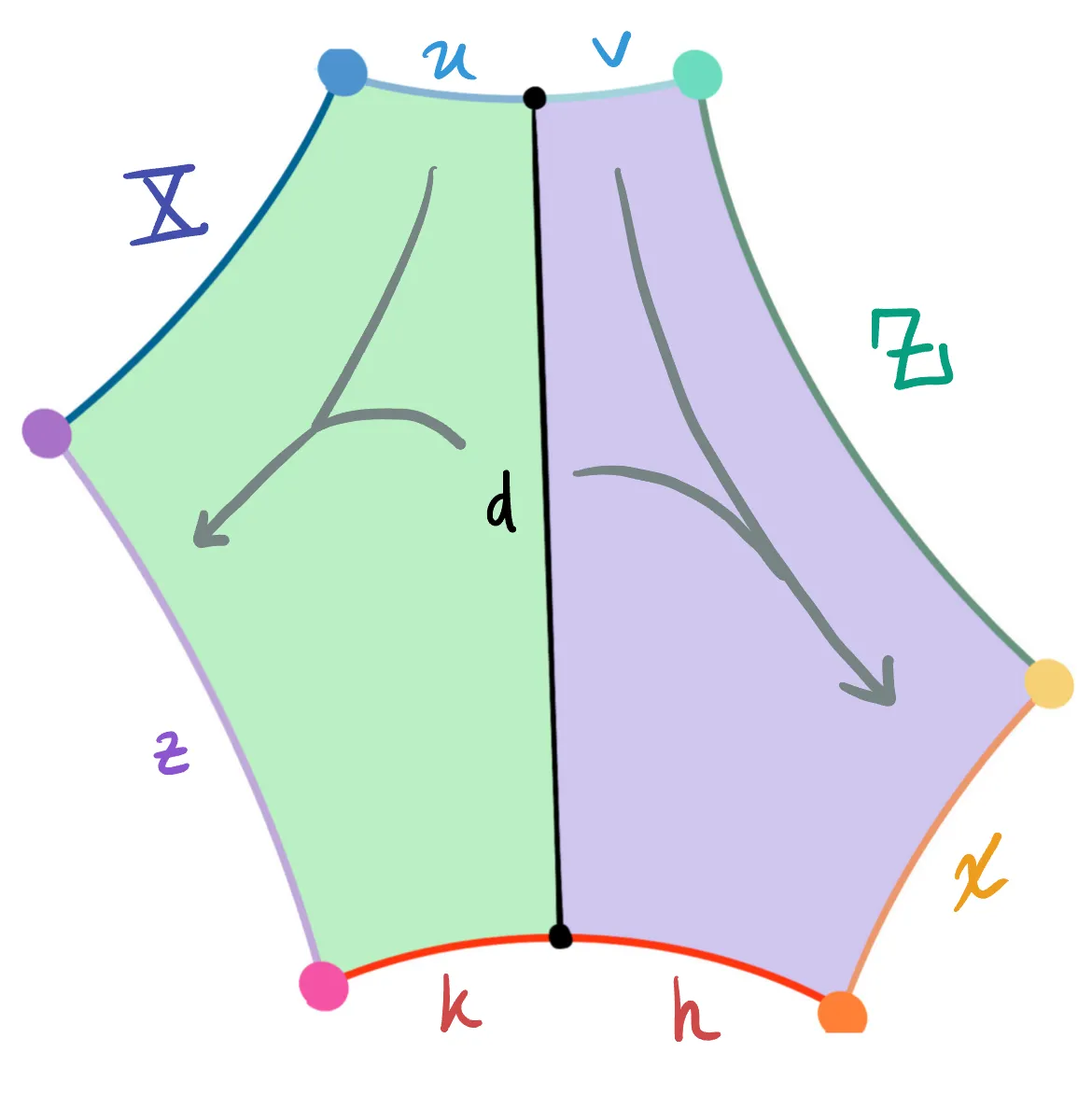
Using the trigonometry of right-angled pentagons, we can write down expressions for each of these (temporarily allowing the use of X and Z).
We do not know the values of X or Z, but we can again use the trigonometry of right angled pentagons to write their hyperbolic sines in terms of known quantities, and the perpendicular d:
sinhZsinhx=coshd=sinhXsinhz
Putting all these together, we do some algebra working towards arriving at an expression for cosh(h+k).
We now just turn back to the original diagram, to see the first term of this sum is actually cosh(x)cosh(z)
This is immediate from yet another application of the trigonometry of right angled pentagons, using the adjacent pairs of sides u,d and v,d:
sinh(u)sinh(d)sinh(v)sinh(d)=cosh(z)=cosh(x)
ALl together then,
cosh(Y)sinh(x)sinh(z)=cosh(x)cosh(z)+cosh(y)
Finally, solving for cosh(Y) gives a formula strictly in terms of known quantities:
cosh(Y)=sinh(x)sinh(z)cosh(x)cosh(z)+cosh(y)
The computation is symmetric under permutation of (X,x),(Y,y),(Z,z) so this yields formulas for all three, as in the theorem statement at the top of the page.
The Hexagon Law of Sines & Cosines
While we are here, we give a quick proof of an often useful fact, the hyperbolic law for right angled hexagons.
Hexagon Law of Sines
If x,y,z and X,Y,Z are corresponding triples of alternating sides of a right angled hexagon, then
sinhxsinhX=sinhysinhY=sinhzsinhZ
We will derive the equality just for the ‘x’ and‘y’sides, as the other pairs of equalities are analogous. Divide the z sides by their common perpendicular, and note this creates two right angled pentagons sharing a common side L. Then using the trigonometry of right angled pentagons on each side, we get two expressions for L:
sinhXsinhy=coshL=sinhxsinhY
Dividing through gives the standard form of the equality.
We should note the similarity to the triangle law of sines is no coincidence: indeed, a right angled hexagon can be uniquely constructed from a ‘hyper-ideal’ triangle, by adding in the (unique) perpendicular bisector of each pair of ultraparallel sides.
PICTURE
A nice trick in hyperbolic geometry is that when geodesics go from intersecting to non-intersecting, formulas involving cosθ for the angle of intersection smoothly transition to formulas involving coshd for d the length of the common perpendicular (and similarly sinθ↦±sinhd). Thus, the hexagon law of sines really is nothing more than the normal law of sines.
sinhxsinχ=sinhysinυ=sinzsinζ
mapstosinhxsinhX=sinhysinhY=sinhzsinhZ
This implies there should also be a ‘Hexagon law of cosines’ based on the second Hyperbolic law of cosines for triangles, which determines a side length implicitly by three angles. Instead, this determines one side in terms of the other triple of alternate sides,
coshx=−coshycoshz+sinhysinhzcoshX
⟹coshX=sinhysinhzcoshycoshz+coshx
This is of course just the formula we derived (with much more work!) above, through the decomposition into pentagons!