Chaos
Julia and Many Paths to the Beach, selected for the juried show "Chaos".
- Venue
- O'Hanlon Center for the Arts
- Location
- Mill Valley, CA
- Dates
- November–December 2024
- Juror
- Chester Arnold
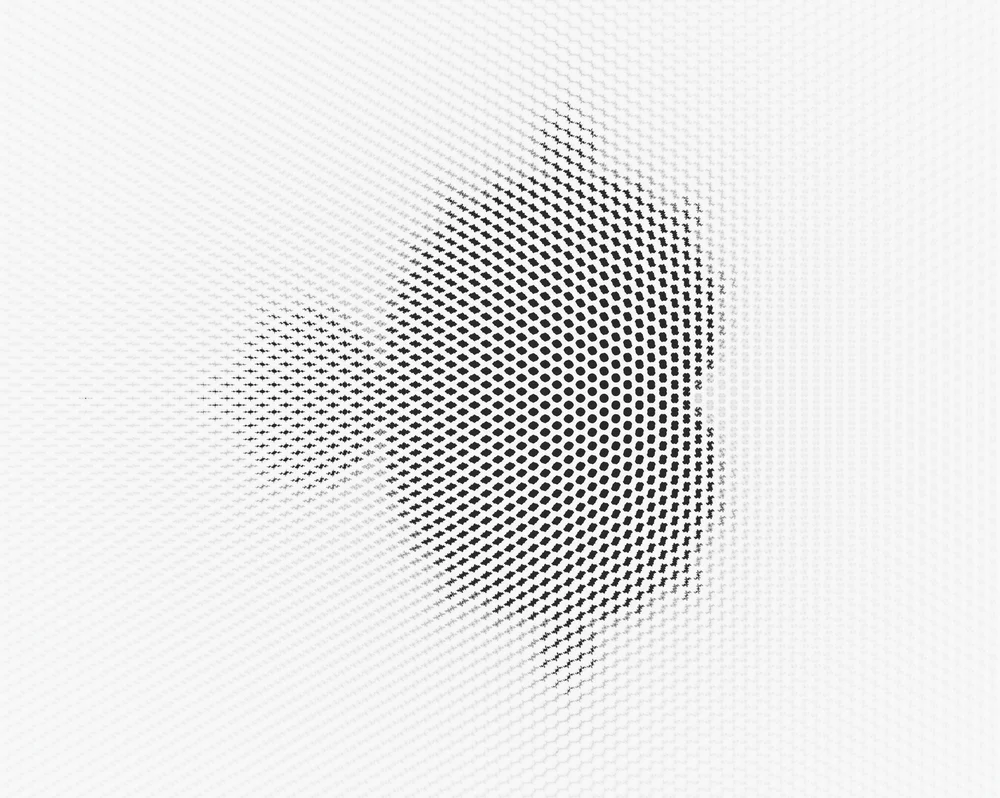
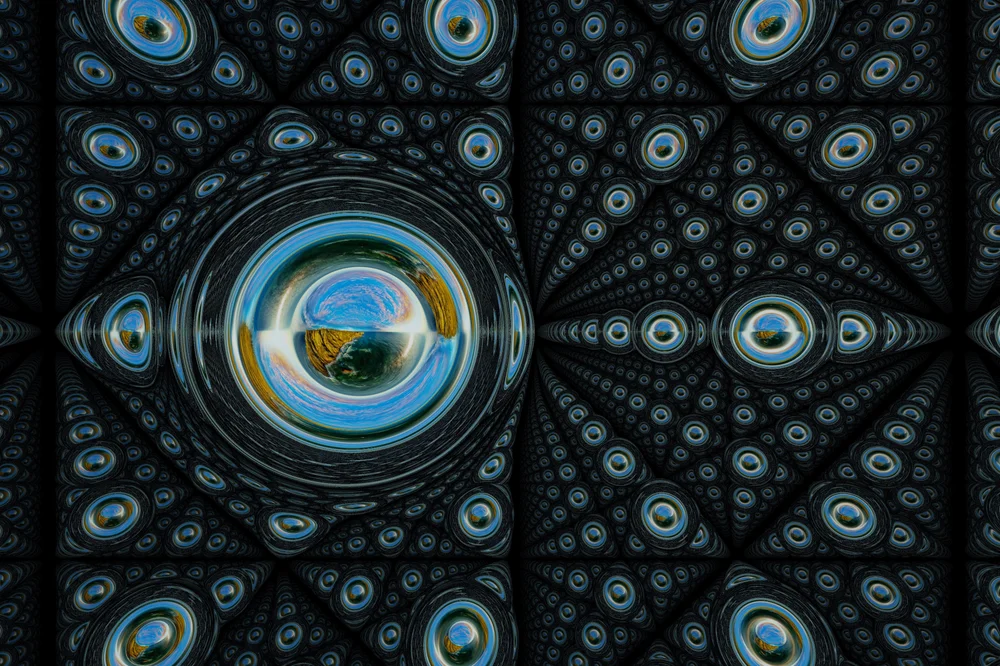
Chaos was a national juried exhibition at the O’Hanlon Center for the Arts in Mill Valley, inviting work that portrays chaos — spontaneous and unpredictable, yet holding to some internal logic. It ran from November 19 to December 19, 2024.
Ninety-five artists submitted more than two hundred works. The painter Chester Arnold, who juried the show, was asked to choose fifty; fifty-seven were hung. Two of mine were among them.
Julia
The fractal look is the least of it. Iterating splits the plane in two. On one part nearby points share the same long-term fate and the map is predictable. On the other — the Julia set — arbitrarily close points are driven apart under iteration, repelling periodic orbits are dense, and a single orbit passes near every point. Chaos does not decorate the Julia set. It is the set where the chaos lives, and it is chaotic nowhere else.
The piece holds thousands of them at once. Each hexagonal cell takes its own center as the parameter and draws that ‘s Julia set. Asking, for each , whether the resulting set holds together in one connected piece traces out the Mandelbrot set — a map of which chaos you get, whose boundary is exactly where that answer changes discontinuously.
The frame is the opposite of its contents. The hexagonal lattice is not merely tidy: it is the densest circle packing of the plane. And the plane is one of only five dimensions in which the densest packing is known at all — the others are 1, 3, 8 and 24, the last two settled only in the past decade. So the most ordered structure the plane admits, with a set defined by unpredictability inside every cell.
Many Paths to the Beach
Here the disorder is in the light. One end of this universe is ordinary infinite space, with a Southern California beach in it. The other end is a flat 3-torus, tightly rolled up. A wormhole joins them. The viewer stands inside the 3-torus and looks down the throat, where the beach lies on the far side.
That is not the only route light can take. A ray can wrap around the compact end many times over before falling down the wormhole and arriving at the beach, and each way of winding delivers another image — one for every homotopy class of paths out to infinity. The result is a mirage: the same stretch of coast repeated across the field of view, each copy carried to the eye along a different twisting path.
The two works sit on opposite sides of the show’s title. Julia is chaotic in the technical sense and looks orderly from across the room. This one is bewildering to look at and perfectly regular underneath — on a flat torus geodesics multiply in an orderly progression rather than diverging, so the confusion is in the seeing and not in the dynamics.