Algebraic Number Starscapes
Pictures of every complex algebraic number of low degree, and the hyperbolic geometry and Diophantine approximation they reveal.
Take every polynomial with integer coefficients up to some degree, find its complex roots, and draw a dot at each one. Size the dots so that simple polynomials get big dots and complicated ones get small dots, and measure sizes in the hyperbolic metric of the upper half plane. The result is a starscape: the plane fills with beaded necklaces of disks that subdivide it into ever finer regions, and around each large dot the smaller ones spiral like the arms of a galaxy.
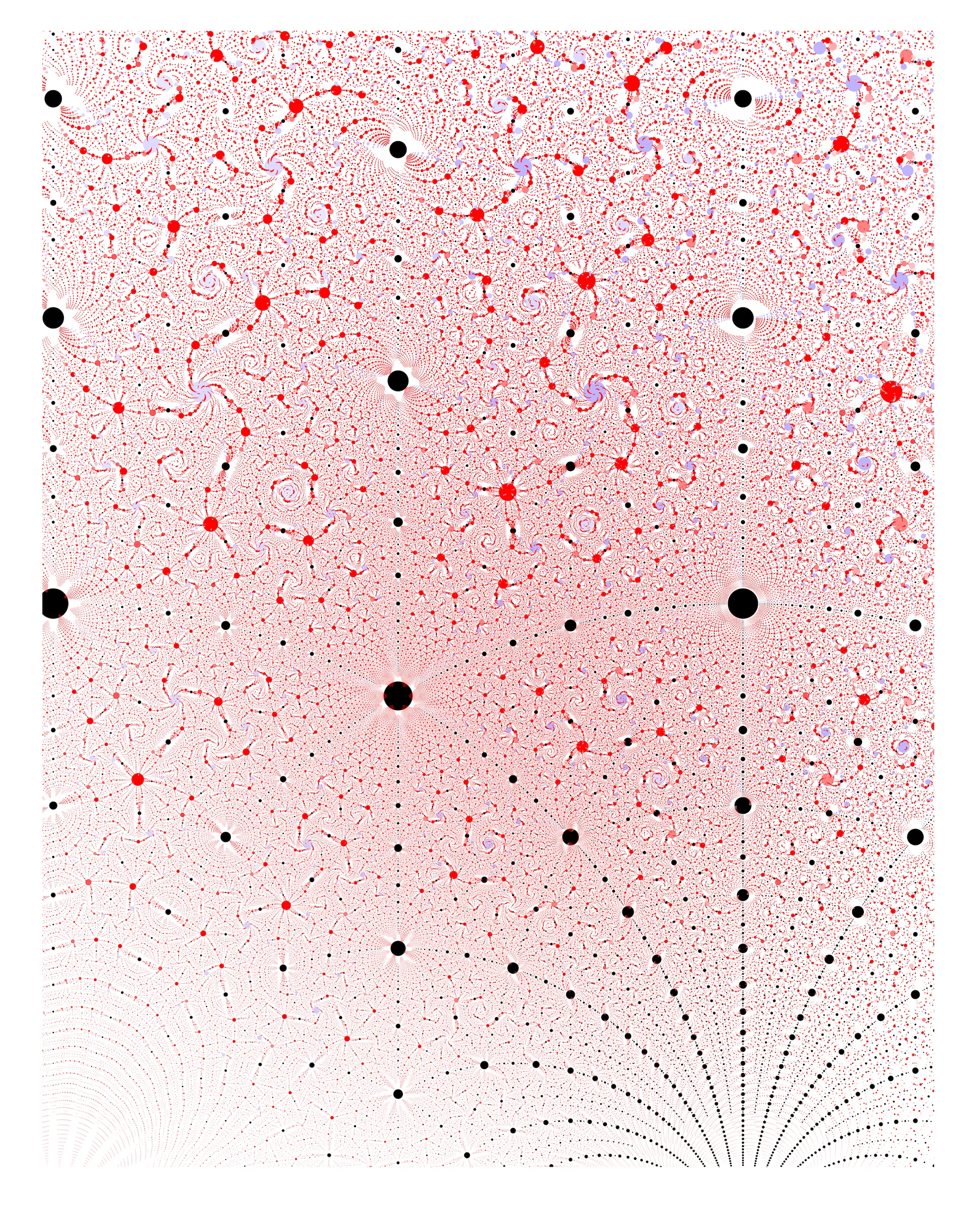
Edmund Harriss, Kate Stange and I made these pictures at ICERM in 2019 and then spent two years working out what we were looking at. The paper that resulted, in Experimental Mathematics, is deliberately written with two paths through it, one for a motivated high school student and one for a researcher in number theory, because we believe the images are a genuine entry point into both hyperbolic geometry and Diophantine approximation.
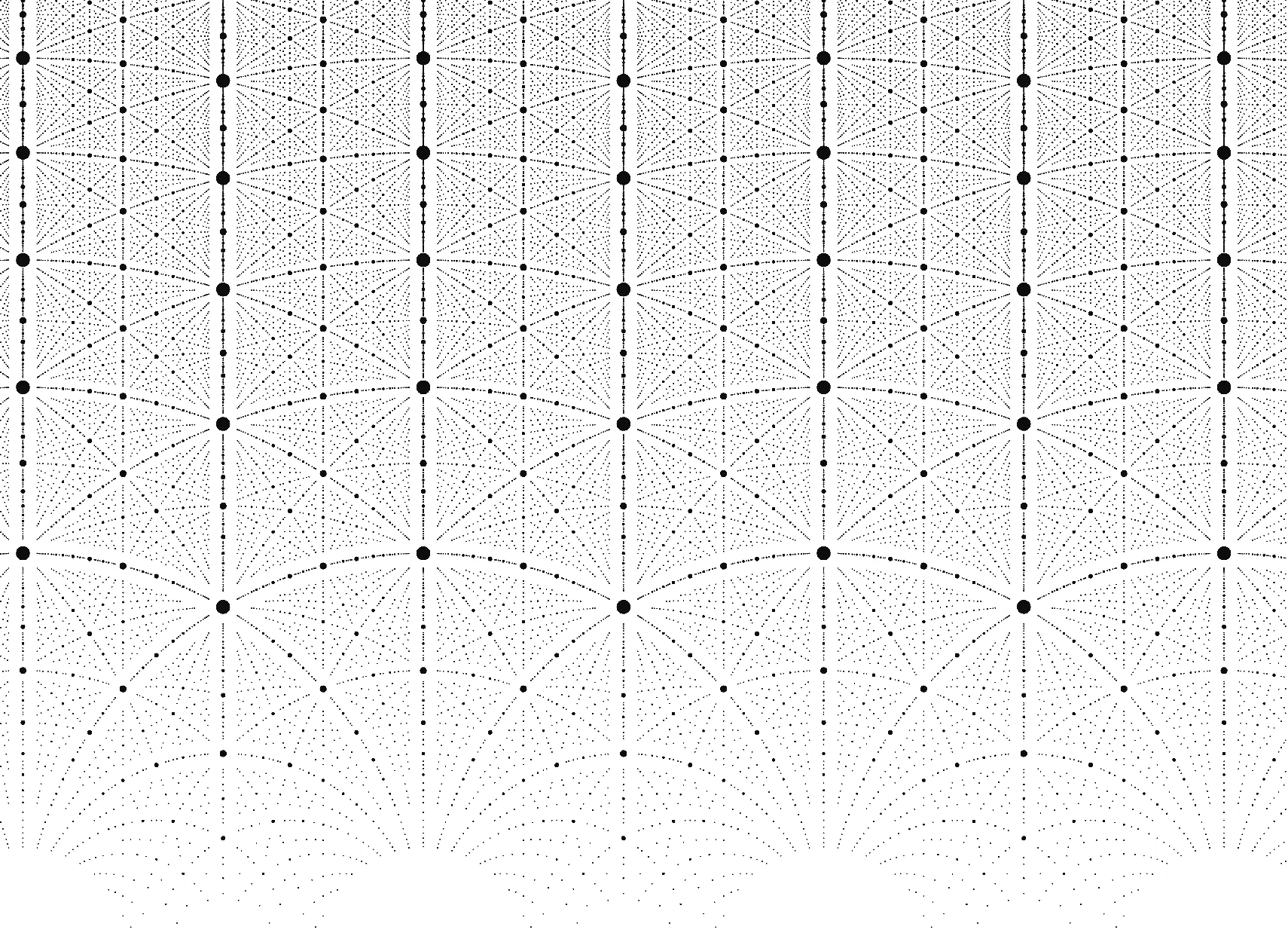
The mathematics splits into geometry and arithmetic. On the geometric side, the space of polynomials of a fixed degree and the space of their roots are both homogeneous spaces for , and the map from coefficients to roots respects that action. In degree two this says something I had never heard, though it must be classical: the quadratic formula is an isometry between two models of the hyperbolic plane! The necklaces in the quadratic starscape are hyperbolic geodesics, and the whole picture is symmetric under the modular group. In degree three the geometric story continues but grows in complexity: the space of real cubics with a complex root is the unit tangent bundle of the hyperbolic plane, and the fact that every real cubic has a real root hands you a trivialization of that bundle. The cubic formula becomes a set of coordinates for it, from a model in projective space bounded by the discriminant variety to the upper half plane times its boundary circle.
On the arithmetic side, Diophantine approximation asks how well a number can be approximated by simpler numbers, and what “simpler” costs. The classical story on the real line runs from Dirichlet to Roth. For complex numbers approximated by quadratic irrationals, Bugeaud and Evertse had found a puzzling dichotomy, where the critical exponent is sometimes 2 and sometimes 3/2. The geometry explains it. Measure closeness by hyperbolic distance and complexity by the discriminant of the minimal polynomial, and the picture organizes the theorem:
Let be a non-real complex number that is not a quadratic irrational.
- For any there are infinitely many quadratic irrationals with .
- If lies on a rational geodesic, there is a constant and infinitely many quadratic irrationals on that geodesic with .
- If is algebraic, both exponents are sharp: for any , only finitely many satisfy either bound with or replaced by or .
The first two parts are Dirichlet-type theorems, and the third is Roth-type, proved with Schmidt’s subspace theorem. The rational geodesics are exactly the necklaces in the picture, which is why they look more densely packed with quadratic irrationals than the space between them. The visual repulsion between large dots is Dirichlet’s theorem, seen.
What I like most about this project is, honestly, where it came from. We started by asking what made an image look interesting, without trying too hard to define interesting, and chasing that turned out to be a reliable path to mathematics. The paper ends with a long list of open problems, and people have begun answering them. Gabriel Dorfsman-Hopkins and his student Shuchang Xu took up the question of what the pictures know about Galois groups in Searching for rigidity in algebraic starscapes (Journal of Mathematics and the Arts, 2022), drawing starscapes that single out the algebraic integers whose Galois group is smaller than the full symmetric group. The images were exhibited in Iceland in 2020, and the software that draws them is on this site.