Discrete Isometric Embeddings
Finding isometric embeddings of discretized surfaces and manifolds into curved ambient spaces by minimizing an energy, beginning with hyperbolic surfaces drawn in three-dimensional space.
Hyperbolic geometry is easy to define and hard to see. The standard models, the Poincaré disk and its relatives, fit an infinite plane into a bounded picture by distorting size, and the one fact that makes hyperbolic geometry different, that area grows exponentially with radius, is exactly what they hide. The sphere has a globe. The hyperbolic plane has no globe: Hilbert proved that no complete smooth embedding into exists, and even for finite pieces the only explicit surfaces are the pseudosphere and a few relatives. Beltrami, in the 1870s, made paper models that crinkle and ruffle where the formulas give out.
Our models are discrete. A region of the hyperbolic plane is triangulated, and each edge is assigned its hyperbolic length. A placement of the vertices in is an isometric embedding of the mesh when the Euclidean length of every edge equals its assigned length, and we find such placements by minimizing the sum of squared length errors over the vertex positions by gradient descent, starting from a perturbed copy of the Poincaré disk and adding a repulsion term so that the surface does not pass through itself. The embedded surfaces buckle and ruffle because a hyperbolic disk contains far more area than a Euclidean disk of the same radius, and the only way to fit that area into space is to fold it.
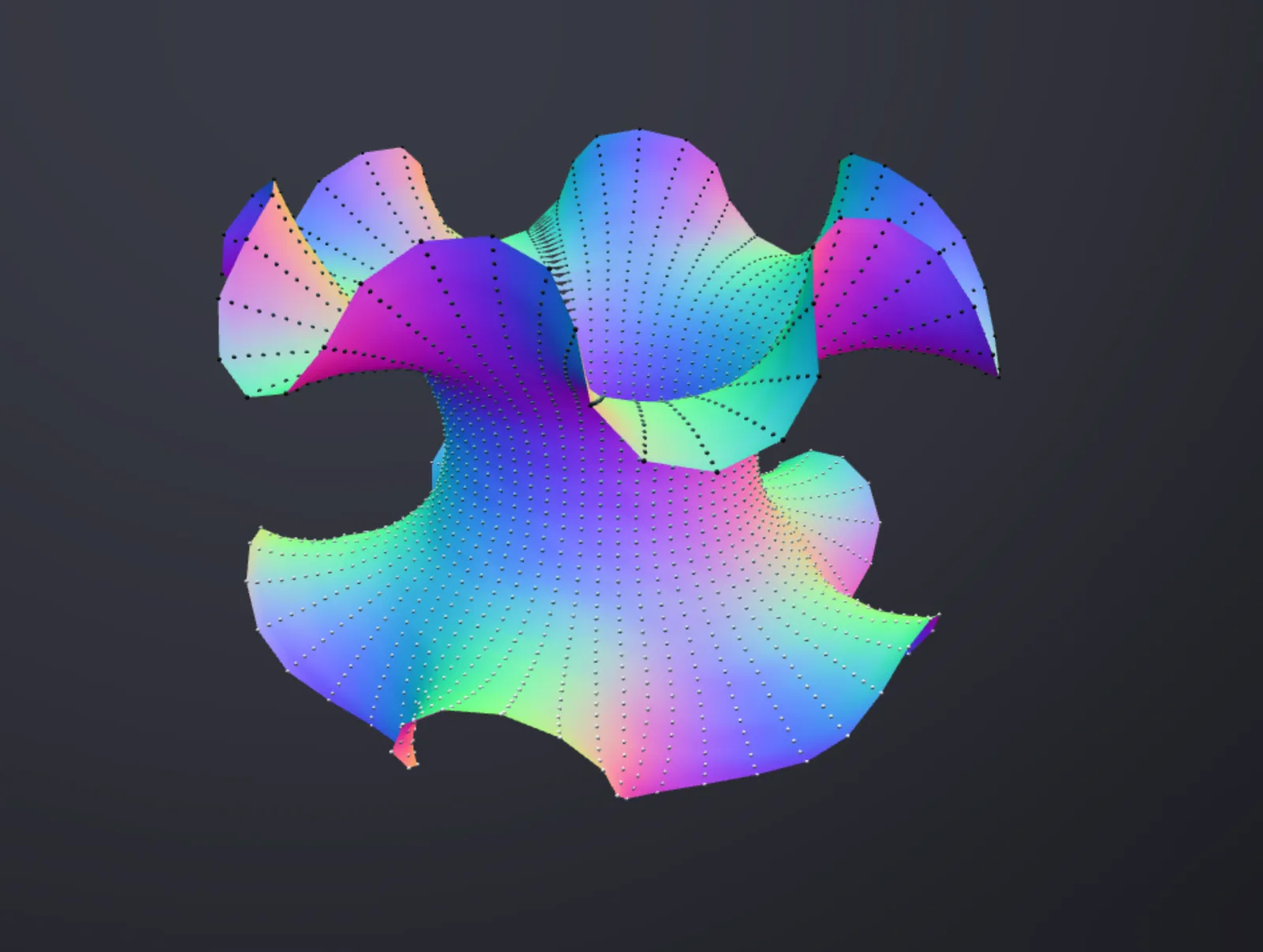
Our Bridges 2026 paper, with Fabian Lander, Erik Loffelholtz, Diaaeldin Taha and Anna Wienhard at the Max Planck Institute for Mathematics in the Sciences, is the first application: drawing hyperbolic surfaces in three-dimensional space. It uses these embeddings as illustrations, concentric disks that visibly explode in size, the strip around a geodesic ruffling like a lettuce leaf, parallel geodesics pulled apart, and turns the method toward design. Coral and kelp are hyperbolic because biological growth is exponential, so a hyperbolic mesh under gravity makes a convincing ruffled dress or a coral reef with no sculpting by hand. We use the models as renders and 3D prints in talks, school visits, and public events.
I really enjoyed working on this. I had wanted to do something like it for a while, but with most of my computational work in GPU shaders I hadn’t thought enough about meshes to know how to get it off the ground. Visiting the Max Planck Institute, I found that Fabi and Dia were interested in a similar thing, so we teamed up, wrote the mesh system from scratch, and I learned a lot in the process.
The general project
Relaxation into Euclidean space is a standard tool. The project with Fabi and Dia is the general version: the ambient space can be anything in which geodesic distance can be computed and differentiated, and the thing being embedded can be a discretized manifold of any dimension.
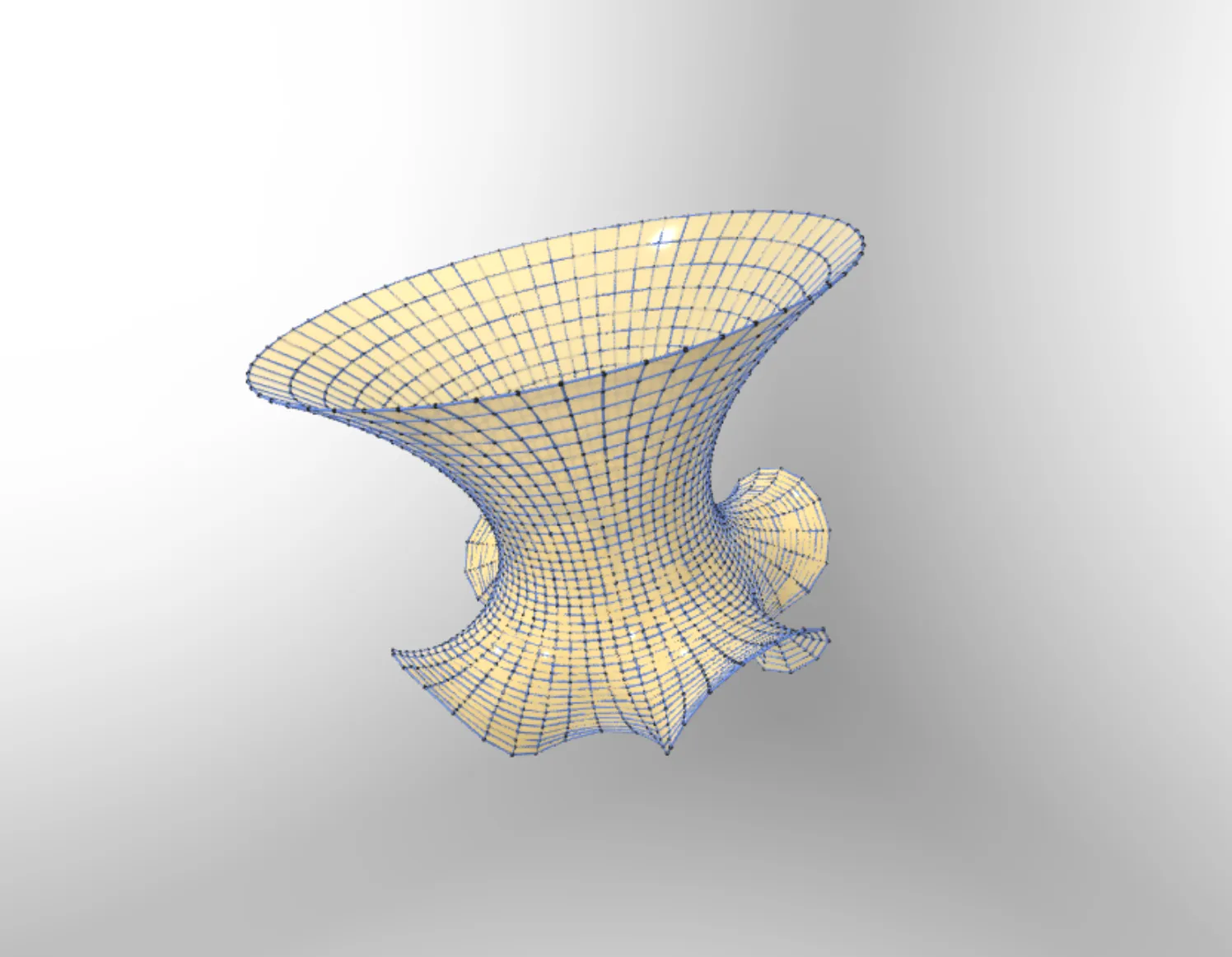
The engine defines an energy on the space of configurations: a function measuring how far the induced discrete metric of a placement of the vertices is from the target metric. It then drives configurations toward minima by whichever evolution suits the problem, gradient descent and its cousins, or Hamiltonian flow with dissipation, which is where the spring-mass picture of the Bridges paper fits in as one special case. The design is modular: any differentiable energy can be slotted in, and any numerical flow, so the same code handles edge-length matching in a curved target, added constraints like pinned vertices or repulsion between distant parts of the surface, and whatever energies later problems call for. It runs on the GPU and every step is differentiable.
Examples include hyperbolic surfaces in Euclidean space and in hyperbolic space, where the difference in how they buckle is the difference in ambient curvature; flat tori in the 3-sphere; and, going up in dimension, a flat three-dimensional torus in and surfaces in . The demo above embeds the optical geometry of a black hole, the Riemannian metric whose geodesics are the paths of light around it, into ordinary space.
From this project
Papers
- Illustrating Hyperbolic Surfaces with Mesh Embeddings