Visualizing Elliptic Curves
Faithful pictures of elliptic curves over the complex numbers and over finite fields, and the equivalence of categories that makes the finite field pictures work.
Elliptic curves are interesting for many reasons, but their pictures are often hard to comprehend. The real case is fine, except that the most important point, the identity of the group, sits at infinity. The complex and finite field cases don’t, to my knowledge, have many useful illustrations at all. Our project with Nadir Hajouji was to change that, and along the way we ended up collecting some beautiful classical mathematics and assembling it into an equivalence of categories.
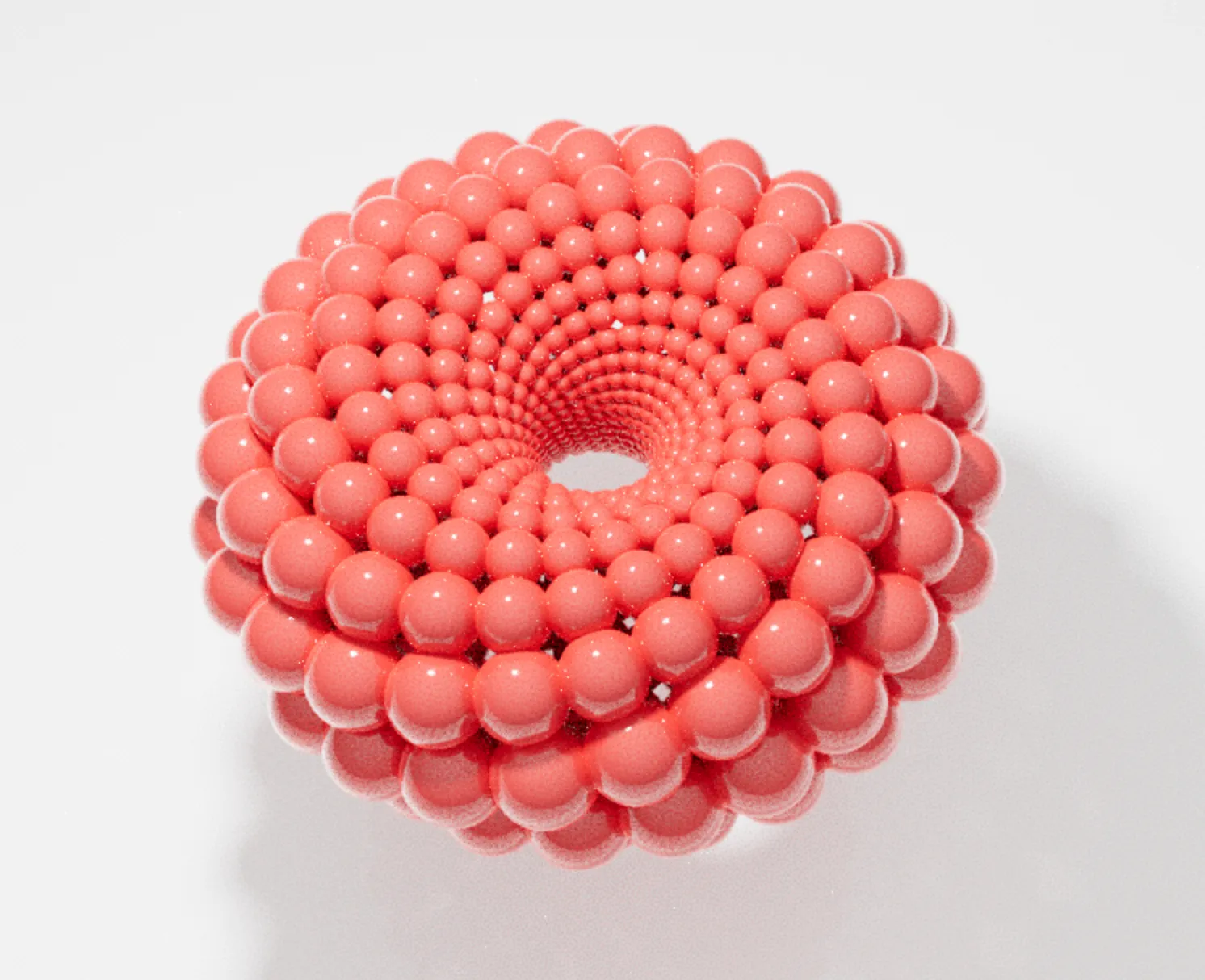
A complex elliptic curve is a torus , and different lattices give tori of genuinely different shapes. To draw one in without lying about its shape the map must be conformal, and there are no flat tori in . Our Bridges 2025 paper gets around this with a theorem of Pinkall: the preimage under the Hopf fibration of a closed curve on the sphere is a flat torus, whose shape is set by the curve’s length and enclosed area. Composing with stereographic projection, which is conformal, lands the torus in with the correct shape, and the paper gives the explicit map so others can use it.
The finite field pictures come from lifting Frobenius. The curve over is also a curve over with complex multiplication by , and the endomorphism reduces to the Frobenius map . On the torus it is multiplication by , and the points of the curve over are its fixed points: a finite subgroup of the torus, which we draw on the torus. The points over , and so on are fixed points of its powers. The result shows the group structure, the Galois action, and the shape of the lattice at once. The pictures were shown at the International Congress of Mathematicians in 2026 and are the source of the art series on this site.
Work in progress
The example works because has class number one. In general there are as many lattices as there are curves with a given endomorphism ring, and the question is which lattice belongs to which curve. Our second paper answers this: the two sides are the same category.
Let be a complex quadratic integer of norm lying in a prime above . Every lattice with admits a Deuring model relative to , and reduction modulo is an equivalence of categories from the lattices with a distinguished endomorphism , with isogenies as morphisms, to the elliptic curves over whose Frobenius has trace .
So every curve over has a lattice, and every such lattice comes from a curve. Computing the correspondence directly means reducing -invariants modulo , which is unpleasant, so the paper also proves that matching up a few isogeny graphs on the two sides is enough to pin the equivalence down.