Optics of Black Holes
Rendering spacetimes with many black holes by turning general relativity into classical optics.
To draw what a black hole looks like you follow light backwards from the camera along the null geodesics of a curved spacetime until it hits something. In principle that is all. In practice it means solving nonlinear differential equations on a spacetime that is itself the solution of Einstein’s nonlinear field equations, and for more than one black hole there is usually no spacetime to solve them on at all, because two black holes orbit, radiate, and merge.
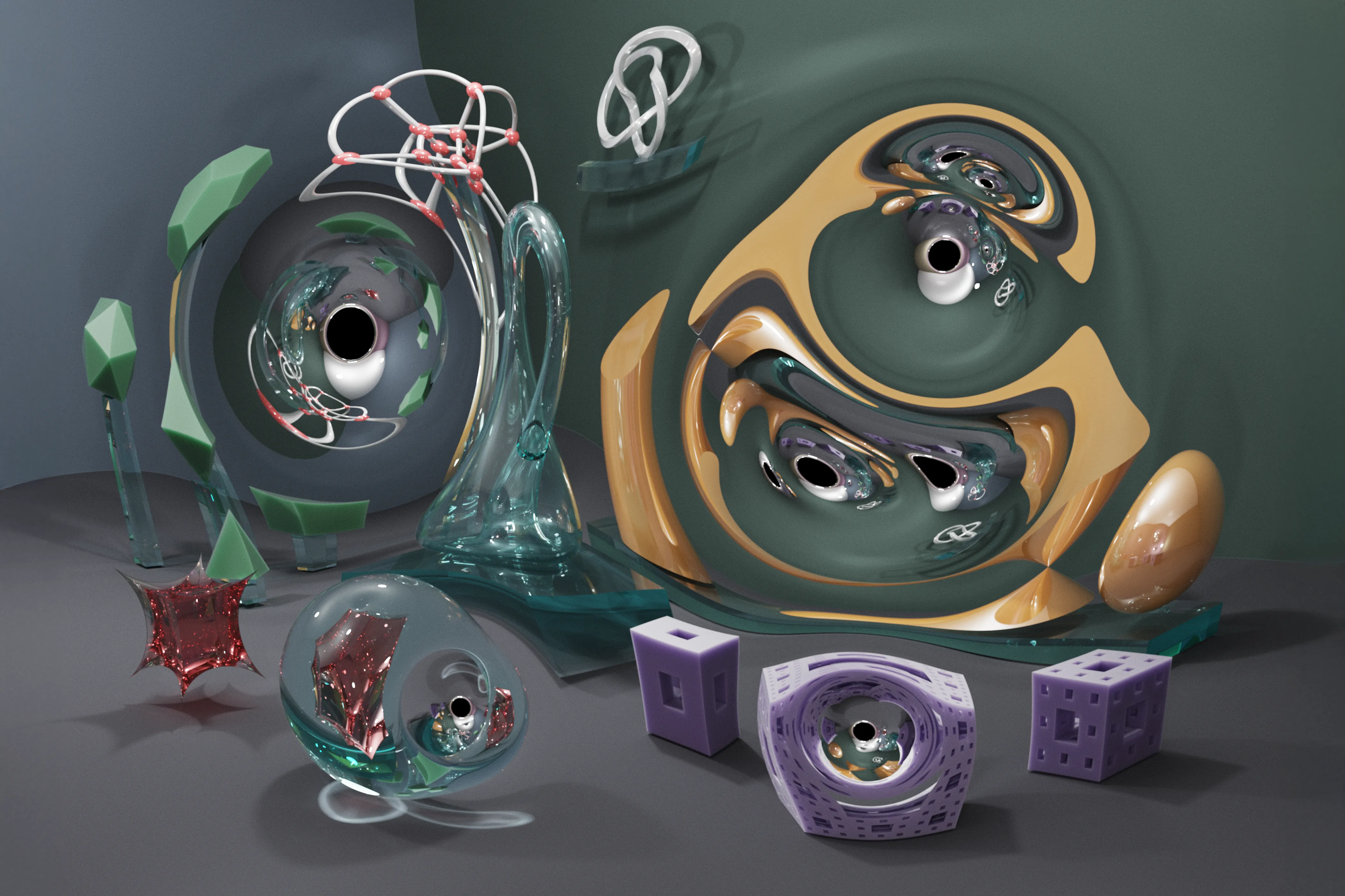
There is one beautiful exception. In 1947 Majumdar and Papapetrou found an exact static solution of the Einstein–Maxwell equations built from any harmonic function on , and in 1972 Hartle and Hawking showed that choosing gives any number of extremally charged black holes sitting perfectly still, their gravitational attraction canceled by electrostatic repulsion. My Bridges 2025 paper starts there and applies three facts from Lorentzian geometry in turn. Null geodesics do not change under conformal rescaling of the metric. In a static spacetime they project to ordinary geodesics of a Riemannian metric on space. And geodesics of a conformally flat metric are, by Fermat’s principle, the paths of light in flat space through a medium of refractive index . Put together:
Ray tracing static objects in the Majumdar–Papapetrou spacetime is equivalent to ray tracing the same objects in flat space filled with a medium of refractive index .
Gravity acts like glass. The correspondence is not automatic. For a general static spacetime the light rays are geodesics of a three-dimensional optical metric, and they are light rays in a medium only when that metric is conformally flat. For a single Schwarzschild black hole it is, as isotropic coordinates make plain — though cheaply, since every spherically symmetric metric on space is conformally flat and the symmetry alone forces it. What is remarkable about Majumdar–Papapetrou is that the optical metric stays conformally flat for any number of black holes, scattered anywhere, with no symmetry to do the work, and the refractive index is then read straight off the harmonic function.
The consequence is that any renderer capable of a spatially varying refractive index can produce exact images of multiple black holes, with no relativity code at all. I did this in my own path tracer, and the paper gives the differential equation for the light paths so that anyone can add it to a hobby renderer in an afternoon. The results include path-traced gravitational lensing of colored lights, where the black holes act as caustic-forming lenses, and real-time renderings of black hole shadows, which trace the chaotic scattering of light between several horizons that Kluitenberg, Roest and Seri had studied analytically.
The goal was to make art. Rendering it needed efficient computation, and working that out became the paper. The still-life diptych and the Lightfall light cones were shown at the National Museum of Mathematics in New York and at the International Congress of Mathematicians in 2026.