Visualizing Knot Complements
Drawing the space around a knot from the inside, by thickening knots in the 3-sphere and projecting from a point on the knot.
Knot theory is the zoology of topology. Its creatures are the knots and links, its species are isotopy classes, and its field guides are invariants, quantities that do not change when a knot is wiggled. The most fundamental invariant is the complement, the space left behind when the knot is removed: by a theorem of Gordon and Luecke, it determines the knot. Topologists work with complements constantly, and to do so they imagine standing inside one, where a tube around the knot forms the boundary of the universe. These images are my attempt to actually stand there.
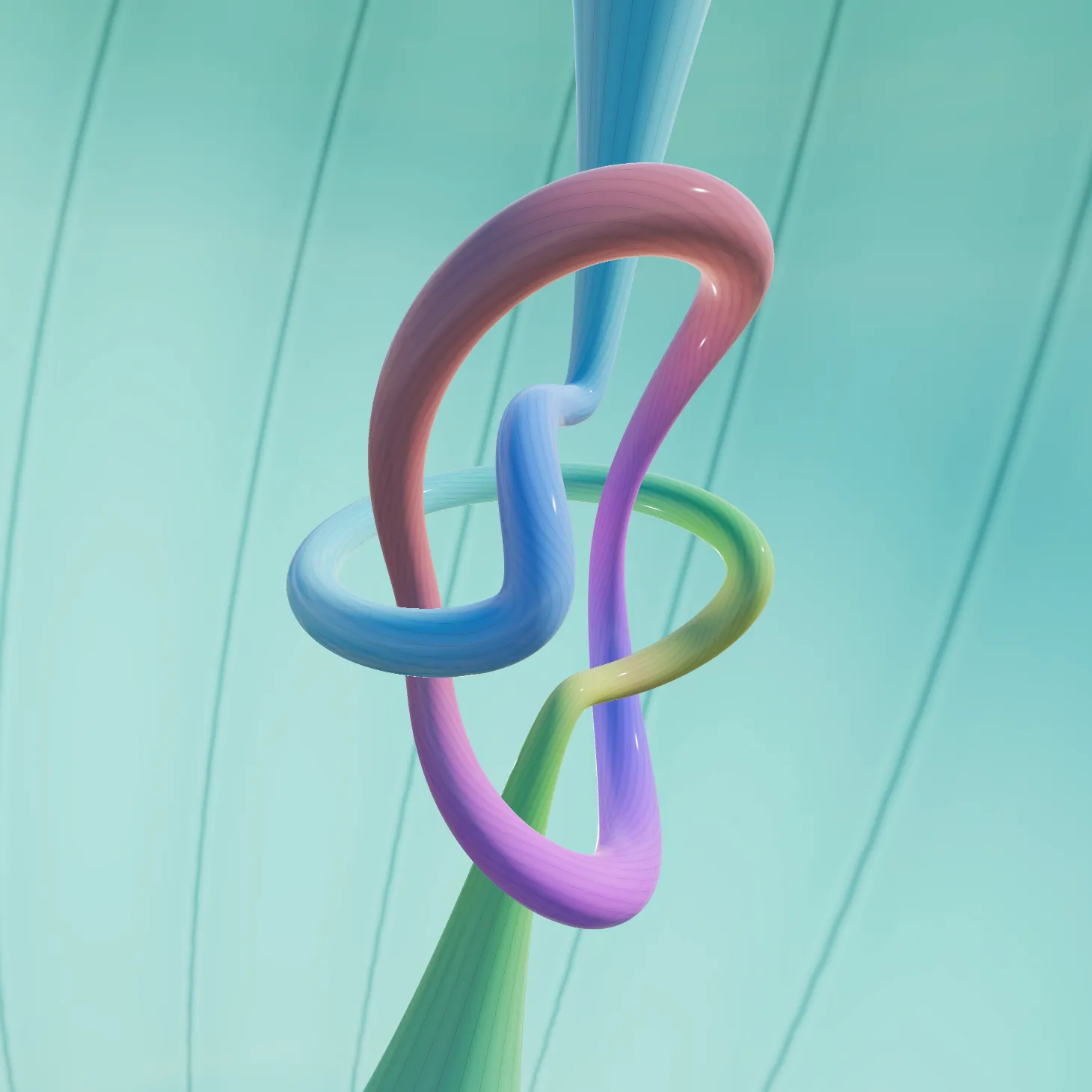
The construction is what you would do in Euclidean space, moved to the 3-sphere, where topologists prefer to take complements. Put the knot in and sweep out the tube of fixed radius around it: in that is a circle in the normal plane of the Frenet frame at each point, and in the frame carries over while the circle is laid down along great circles with the exponential map. Then project. Ray tracing inside the 3-sphere shows almost nothing, because positive curvature hides the complement even with a wide-angle lens. Instead, stereographically project from a point on the knot itself. The knot passes through infinity, and the complement, which was an infinite space, becomes a bounded region of ordinary space with the tube as its wall. Cut a slit in the wall, write a renderer, and look inside.
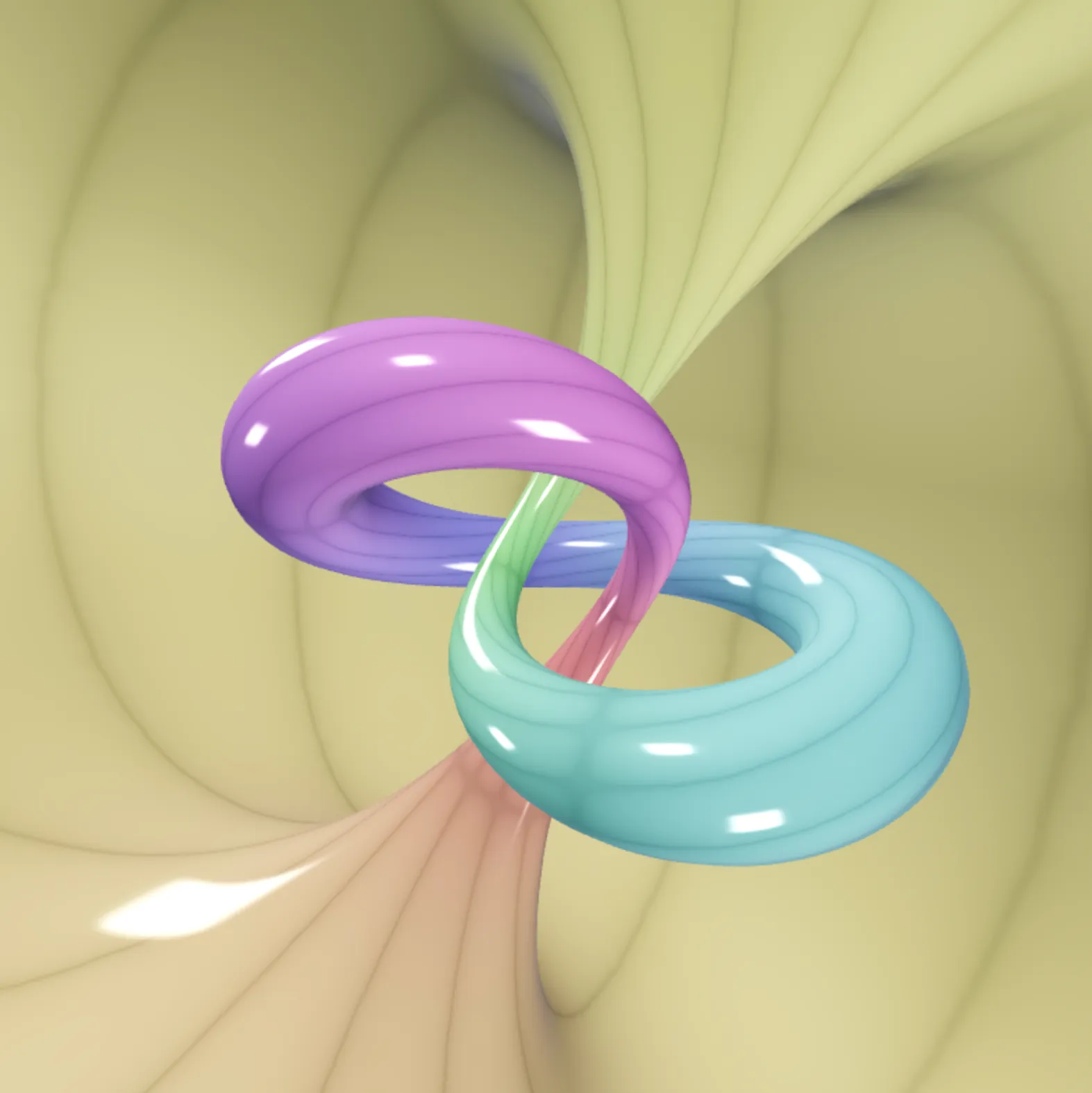
That picture is extrinsic: it shows the complement sitting inside a copy of , with the projection doing the distorting. A complement also carries a geometry of its own, and to see that one ray traces inside the manifold rather than looking at a model of it from outside. I have built both views for two links. The Whitehead link complement is a cusped hyperbolic 3-manifold of finite volume, so its interior is a ray trace in , where the tube wall is replaced by cusps running out to infinity. The Hopf link complement is not hyperbolic at all — it is , and carries a flat metric — so the same interior view is a Euclidean one.
The pictures were published as an Art Department column in MAA FOCUS, with the Whitehead link on the cover, and prints were shown at the Joint Mathematics Meetings and the MAA Golden Section meeting.